


If you've been researching a move to Florida, you've probably asked this question at least once: Is the East Coast or West Coast better?
Here's the honest answer — it's not about which coast is better. It never has been.
Both coasts are growing. Both have beautiful beaches, strong real estate markets, and a lifestyle that's hard to find anywhere else in the country. But when you look closer — at how they're built, how their economies work, and how people actually live on each side — you'll find two very different versions of Florida.
In this post, I break down five key areas that matter most when you're deciding where to plant roots: location and lifestyle, new home inventory, cost of living, jobs and economy, and long-term growth.
1. Location & Lifestyle — You're Choosing an Ecosystem, Not Just a City
One of the biggest mistakes people make when comparing the two coasts is thinking about individual cities in isolation. The reality is, you're not just choosing a city — you're choosing which Florida ecosystem you want to orbit around.
The West Coast, particularly Southwest Florida, feels geographically compressed in the best way. Sarasota sits in the middle of a lot. You get the relaxed beach lifestyle, the culture, the restaurants, the slower pace — but Tampa and St. Pete are right there, Orlando is a couple of hours away, and Naples and Fort Myers are just south. The Gulf Coast feels connected without feeling hectic. Different metros feel tied together, and it's easy to mix up experiences without committing to one kind of lifestyle full time.
The East Coast is more fragmented — and that's not a knock, it's just a different structure. Jacksonville and Miami genuinely feel like different worlds. There's more variety, but also more commitment depending on where you land.
Here's how it breaks down by region:
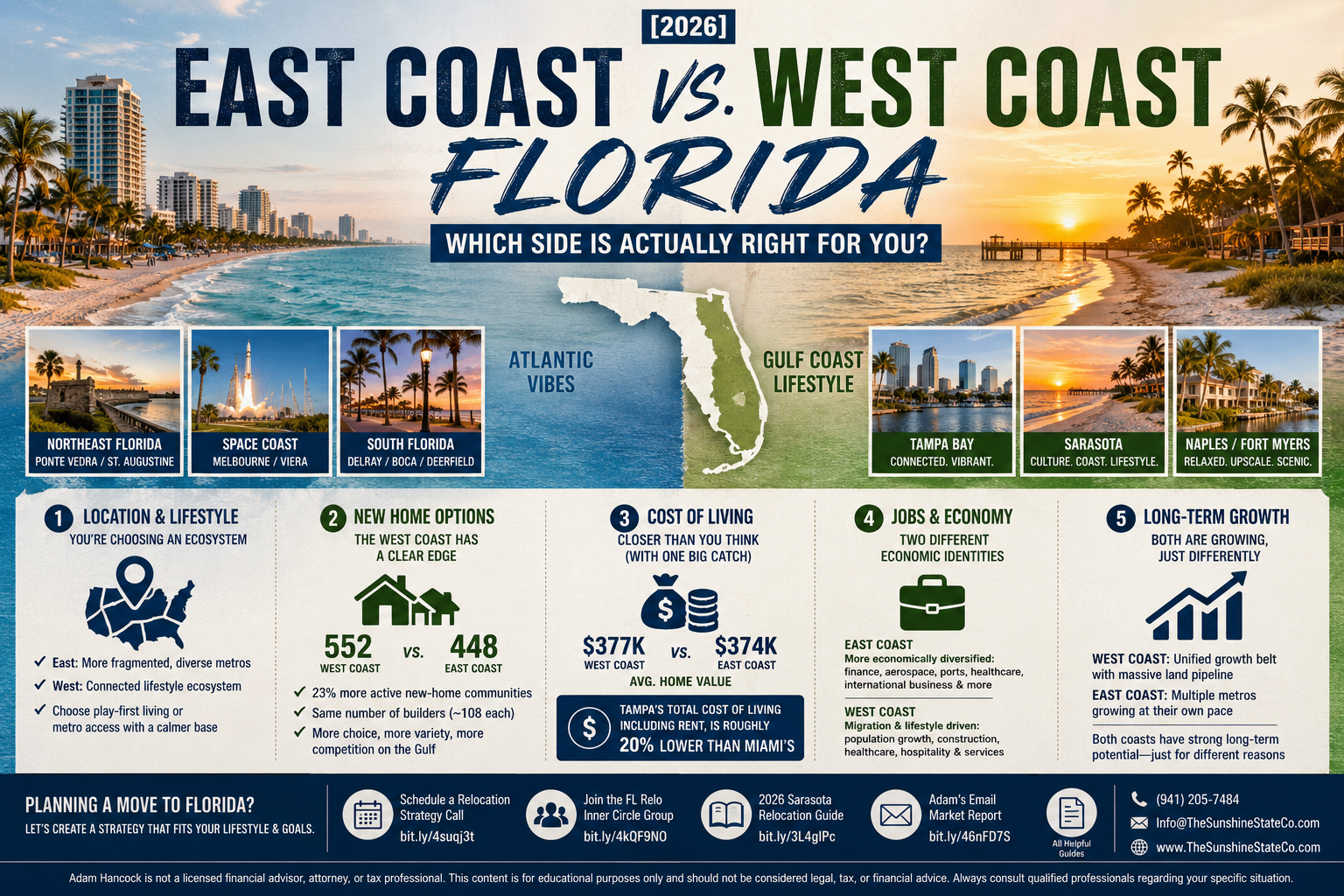
Northeast Florida (Ponte Vedra / St. Augustine) — Historic coastal town feel with Jacksonville access. You get the beaches, the golf, the slower pace, but an NFL city, major airport, healthcare system, and job market are all nearby.
Space Coast (Melbourne / Viera) — A quieter beach lifestyle backed by an aerospace and engineering economy. You're close to Orlando, theme parks, cruise ports, and a solid regional airport.
South Florida (Delray / Boca / Deerfield) — More relaxed day-to-day coastal living with restaurants, walkability, beaches, and boating. Miami and Fort Lauderdale are accessible when you want the energy — but you don't have to live inside the intensity full time.
The takeaway: Some people want play-first living with optional city access. Others want major metro access with a calmer home base nearby. That answer will point you to the right coast more than anything else.
2. New Home Options — The West Coast Has a Clear Edge Right Now
If you're looking at new construction — and most people relocating to Florida are — this data point might surprise you.
The West Coast currently has roughly 23% more active new-home communities than the East Coast — 552 vs. 448. And here's what makes that number even more significant: both coasts have essentially the same number of builders, about 108 each. More communities per builder on the Gulf side tells you something important about how this market is structured.
Over 73% of West Coast new-home activity is concentrated around the greater Tampa Bay areas to Sarasota. That kind of concentration creates a density of choice — more communities to compare, more price points, more builders competing for your business.
On the East Coast, new homes are more spread out across Jacksonville, Daytona, and the Treasure Coast. There are solid options, but they feel more siloed and separately developed rather than part of one massive master-planned ecosystem.
The takeaway: If new construction and master-planned community living is important to you, the West Coast currently has a clear advantage in both inventory and variety.
3. Cost of Living — Closer Than You'd Think (With One Big Catch)
Here's what surprises most people: overall home prices are remarkably close between the two coasts.
West Coast average home value sits at around $377K. East Coast comes in at around $374K. Nearly identical on the surface.
But the market-by-market breakdown tells a more nuanced story:
West Coast markets:
- Naples / Collier County — ~$559K
- Sarasota-Bradenton — ~$404K
- Tampa Bay — ~$358K
- Fort Myers — ~$340K
- Punta Gorda — ~$298K
East Coast markets:
- Miami / Broward / Palm Beach — ~$473K
- Treasure Coast — ~$381K
- Jacksonville — ~$349K
- Daytona — ~$328K
Naples is the luxury outlier on the Gulf side. South Florida is the expensive anchor on the Atlantic side.
On recent market movement, the West Coast experienced a more aggressive run-up during the pandemic cycle and is now seeing a larger correction — down about 6.7% over the past year vs. 3.1% on the East Coast. But over five years, the East Coast has appreciated slightly more, up about 33% vs. 28% on the West.
Where the East Coast gets expensive fast is carrying costs. Property taxes run about 1.65% on the East vs. 1.56% on the West. Homeowners insurance averages around $3,775 annually on the East vs. $3,579 on the West — and those numbers are heavily skewed by South Florida, where Palm Beach (~$6,351), Broward (~$6,165), and Miami-Dade (~$5,960) are dramatically higher than the state average.
The big comparison to understand: Tampa's total cost of living, including rent, is roughly 20% lower than Miami's. Tampa rents specifically run about 24% lower. South Florida is effectively operating in a different economic tier than most of the rest of the state.
4. Jobs & Economy — Two Very Different Economic Identities
This is where the two coasts diverge most sharply beneath the surface of the housing market.
The East Coast is generally more economically diversified. You have major international business influence in South Florida, port activity in Jacksonville, aerospace and defense around the Space Coast, finance and healthcare clusters, and stronger institutional employment bases overall. South Florida almost functions like a global gateway economy — international capital, Latin American business influence, finance, tourism, and wealth migration create a very different economic profile than most Gulf Coast markets.
The West Coast economy is more migration and lifestyle driven. A larger percentage of economic growth is tied to population inflow, construction, healthcare, hospitality, retirement migration, and the service sector that expands to support new residents. Population growth itself becomes the economic engine.
A few standouts worth noting:
Tampa Bay is probably the closest thing the West Coast has to a fully diversified large-scale economy. It has increasingly become a white-collar growth hub with finance, healthcare, tech, logistics, and corporate relocation activity all contributing.
Jacksonville is quietly one of the strongest pure employment centers in the state — logistics, military presence, healthcare, finance, and port infrastructure make it an employment base that doesn't get nearly enough credit.
The Space Coast is unique because aerospace and defense is a fundamentally different economic driver than what you typically see anywhere else in Florida.
The takeaway: The West Coast may currently have the stronger quality-of-life migration momentum, but the East Coast has the broader economic diversification overall.
5. Long-Term Growth — Both Are Growing, Just Differently
The most important thing to understand about long-term Florida growth is this: both coasts are growing — just for very different underlying reasons.
The West Coast currently has the more unified long-term expansion corridor. Tampa Bay through Sarasota down toward Fort Myers is starting to feel like one continuous growth belt. There's still enormous land pipeline available in Pasco, Parrish, Wellen Park, North Port, eastern Manatee, and eastern Hillsborough. Builders can continue creating massive master-planned communities at scale for years to come.
The East Coast will likely grow in a more fragmented way — multiple independent metros each expanding at their own pace. South Florida is already relatively mature and constrained. Long-term growth there will increasingly shift toward redevelopment, urban density, and infill rather than outward suburban expansion.
Jacksonville probably has one of the highest long-term growth ceilings in the entire state, simply because of its affordability, logistics positioning, military infrastructure, and remaining room for expansion.
Tampa Bay may ultimately become the anchor economic engine of the Gulf Coast in the same way South Florida anchors the Atlantic side.
Southwest Florida markets — Sarasota, Naples, Fort Myers — remain heavily tied to migration economics, where population inflow itself is the engine.
The Gulf Coast appears to be winning the battle for large-scale lifestyle migration right now. The East Coast may ultimately prove more economically resilient long term because of its diversification — but the West Coast may continue seeing stronger master-planned suburban expansion momentum over the next decade.
The Bottom Line
There is no universally "better" coast in Florida.
The real question is which one aligns with how you actually plan to live.
If you want a connected lifestyle ecosystem, more new construction options, and a slightly lower cost of carrying a home — the West Coast, especially the Southwest Florida corridor, is hard to beat right now.
If you want more economic diversity, stronger employment-driven growth, or the unique appeal of South Florida's global energy or the Space Coast's aerospace community — the East Coast offers something the West simply doesn't.
People aren't just choosing cities. They're choosing which version of Florida they want to live inside. Figure that out first, and the coast will pick itself.
Check out this article next