



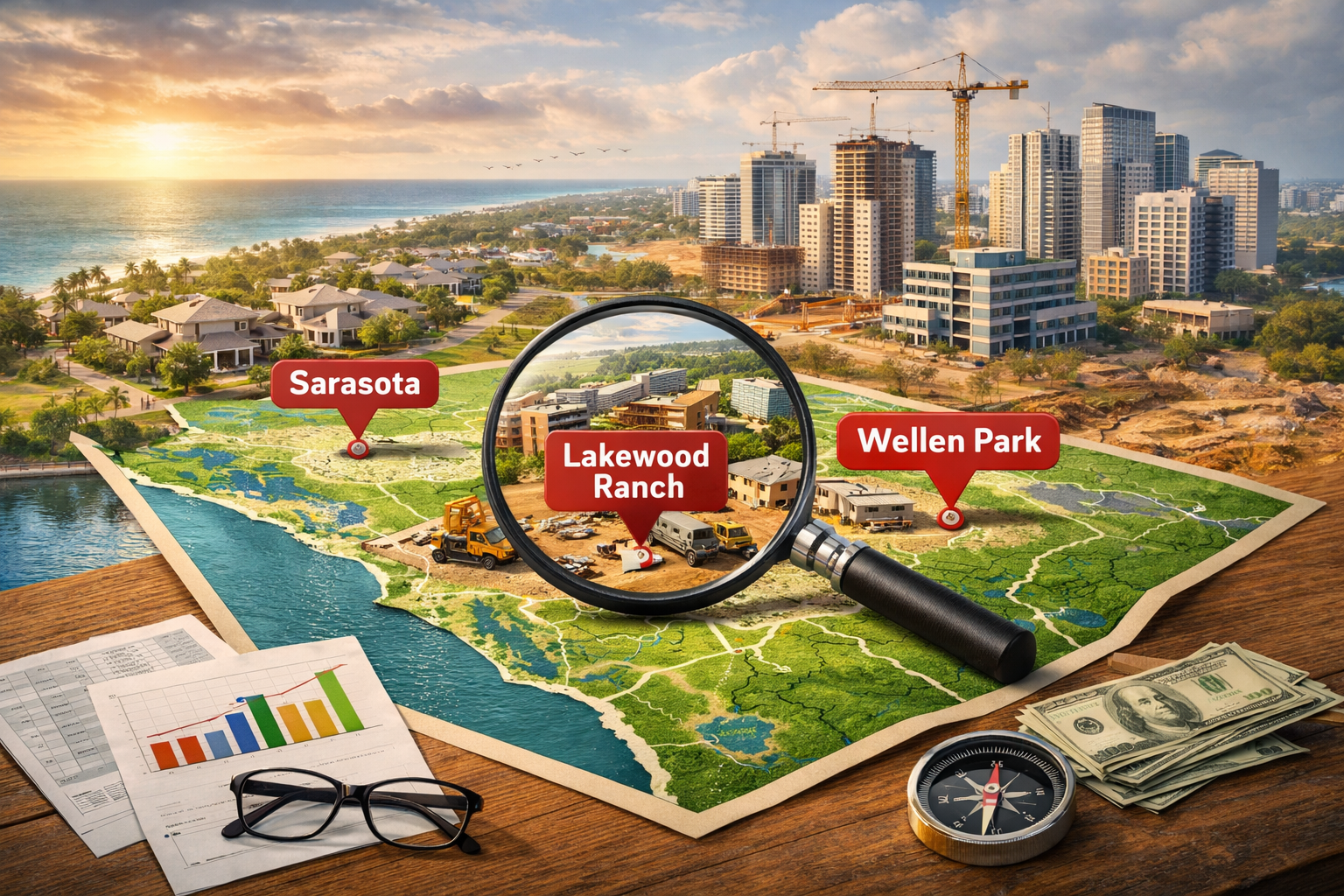
When people think about developers building new communities, shopping centers, and mixed-use spaces, they usually just think of it as more development.
But I look at it a little differently.
In my opinion, most developers are not moving first on emotion. They’re moving on data. They’re studying migration patterns, absorption rates, household income trends, traffic studies, school enrollment projections, and infrastructure expansion plans. They are not guessing as much as people think. They are placing very large bets based on where they believe momentum already exists today in 2026, and more importantly, where they think it will continue.
That does not mean every development is going to succeed. It does not mean that just because commercial construction is coming, you should buy there. But it does give us a map.
When billions of dollars start concentrating in certain corridors, that usually signals something. It signals where density is likely to increase, where new retail will follow the neighborhoods that were just built, where restaurants and services will cluster, where roads will expand, and where the lifestyle of an area could look very different five years from now than it does today.
If you are relocating to Southwest Florida, that context matters.
If you are already under contract, you probably want to know what is coming around you by the time you get to town. Is the area going to fill in? Are shops, medical, grocery, and mixed-use projects going to follow? If you have not chosen yet, watching where developers are concentrating these investments can help you understand where momentum and stability are likely to form, because development tends to cluster. It is not usually scattered randomly.
Below are the areas where I think developers are placing some of their biggest bets in Southwest Florida right now, and what that may tell us about the future of those areas.
South of Sarasota: Wellen Park, Venice, and North Port
One of the most interesting areas right now is south of Sarasota, particularly the west side of North Port and the southern side of Venice. The center of that conversation is Wellen Park.
Historically, going this direction was viewed by a lot of people as a more laid-back, more affordable alternative to the main Sarasota area. When most people think of Sarasota, they think of downtown Sarasota, Lido Key, Longboat Key, Siesta Key, the shopping villages, the art, and the culture. Most of that development was concentrated much farther north.
By contrast, this area sat roughly 45 minutes south, and for years many people chose it because it offered relative affordability, or because they wanted to be close to the coast in newer housing. That was the early appeal of places that were once grouped into the West Villages. Communities like Grand Palm, Renaissance, Oasis, Gran Paradiso, and Sarasota National gave buyers something that used to be very hard to find in this region: new construction reasonably close to the beach.
That was a big deal, because new construction and coastal access are not usually synonymous in Florida. Most of the most desirable coastal areas were already built out.
Fast forward to today, and that original concept has become much bigger. The area was rebranded as Wellen Park, and what was once a smaller cluster has grown into a much more complete place. There are now more than 20 neighborhoods in the broader Wellen Park conversation, with several additional communities either launching or coming soon, including names like Ashcombe, Westlake, and Esplanade at Wellen Park.
What makes this area notable now is not just the amount of housing. It is the way the supporting infrastructure is following it.
Once you build that many homes, people need the rest of life to come with it. That means mixed-use space, retail, dining, services, schools, and everyday conveniences. Wellen Park has already moved beyond the idea of being just a collection of neighborhoods. Downtown Wellen has become a real anchor, and that downtown footprint is expanding. Wellen Park High School is another major addition, giving the area a more complete and self-contained feel while also relieving pressure on older schools that were not built for this level of growth.
That changes the perception of the area.
I do not think this is just an offshoot of Sarasota anymore. It is not simply the place people go because they cannot go somewhere else. More and more, it is becoming a place people choose on purpose. Buyers are comparing it directly against Sarasota, Lakewood Ranch, northern Naples, Estero, Bonita Springs, and even parts of Tampa Bay.
And there is more coming.
A major announcement in this same corridor is a roughly 500,000-square-foot mixed-use project from Benderson, the group behind much of the development around University Town Center. That matters because Benderson’s involvement tends to signal confidence in the long-term trajectory of an area. The expectation is more retail, dining, services, walkability, and public gathering space right near downtown Wellen.
Then just south of that, the team behind Wellen Park has also announced Winchester Ranch, a separate large-scale community planned for the same broader region. If built as proposed, it would include roughly 9,000 homes across thousands of acres, plus commercial and industrial space. There are still approval questions around roads, flooding, and infrastructure, but the scale of the proposal tells you a lot.
Even during the period when prices in this area were correcting from their COVID highs, sales activity remained strong. That is what makes this area so interesting. There is still real demand underneath it.
If you have been looking at this area and have heard people dismiss it as too far, I would just say this: “too far” only matters if it is far from something you truly need to be near. And over the next few years, this area may have more and more of what many buyers need without requiring them to leave town nearly as often.
Southeastern Lakewood Ranch
Lakewood Ranch is another area where the development story matters, but in a slightly different way.
The more a town grows, and the more buyers have multiple options to do similar things within it, the more the differentiators become location and how you live relative to the town itself. Yes, you may want new construction. Yes, you may want a master-planned environment. But two neighborhoods in the same master plan can still live very differently day to day depending on where they sit.
That is especially true in Lakewood Ranch.
Its value proposition has always been different from Wellen Park. Wellen Park offers a strong coastal-new-construction play south of Sarasota. Lakewood Ranch, on the other hand, offers large-scale master-planned living with stronger access to the core Sarasota amenities that made the region popular in the first place.
Lakewood Ranch is northeast of downtown Sarasota. Depending on where you are, you might be around 7.5 to 20 miles from downtown. That means your day-to-day access to places like downtown Sarasota, St. Armands Circle, Lido Beach, and lower Longboat Key can vary significantly based on where in the Ranch you live.
And Lakewood Ranch is not just large. It is massive. At more than 30,000 acres with dozens of communities, multiple commercial districts, and a growing network of schools, parks, and shopping centers, it is a full part of town now.
What is especially interesting today is the southeastern expansion.
Lakewood Ranch has historically developed in phases and quadrants. The earlier neighborhoods filled in the middle. Then development expanded north and east. Later, Waterside became a major shift in the conversation because it brought Lakewood Ranch closer to Sarasota and placed buyers in a lower, more strategically located part of the master plan.
That mattered because it challenged the classic suburban tradeoff. Traditionally, going farther out meant getting more house, more land, and more value. But if a newer area is only a little farther from Sarasota than an older one, the argument for buying much older resale starts to change.
That is what helped make Waterside so popular. And now, as Waterside matures, attention is shifting to the southeastern expansion beyond it.
This next phase is expected to add roughly 5,000 more homes. Several major builders are already attached to the area, including Taylor Morrison, Pulte, Neal Communities, Neal Signature, John Cannon, and Toll Brothers. Some of the specific product types range from townhomes and single-family homes to semi-custom and more upscale options.
That kind of builder lineup matters because it gives buyers pattern recognition. If you have already toured some of these brands elsewhere in the Sarasota region, you have a much better sense of what is coming.
The other big detail here is roads.
Road infrastructure is not the most glamorous part of the conversation, but it matters enormously in a place like this. Sarasota and Lakewood Ranch live on a grid. The way roads connect north to south and east to west directly affects school commutes, beach access, traffic patterns, and daily quality of life.
That is why the extension of roads like Bourneside is meaningful. As new neighborhoods come online in the southeastern part of Lakewood Ranch, better road connectivity will help residents move south more directly and reach corridors like Fruitville and Clark more efficiently. Those are the roads that eventually help connect you to central Sarasota and the beaches.
So the story here is not just more houses. It is more houses in a part of the Ranch that may become increasingly compelling because of where it sits and how the transportation network around it is improving.
By 2027, this lower portion of Lakewood Ranch should become much more active and much more relevant to buyers trying to stay closer to Sarasota while still getting new construction in a master-planned setting.
Palmer Ranch and Southern Sarasota
Another area that has started to re-emerge in a meaningful way is southern Sarasota, especially the broader Palmer Ranch conversation.
Palmer Ranch is not new. It is one of the more established suburban areas in Sarasota and has been around long before many of the current master-planned communities farther east and south became household names. It has more than 20 neighborhoods, and most of them are fully in resale today.
Years ago, Palmer Ranch represented a very attractive suburban solution in Sarasota. It was well located, thoughtfully laid out for its time, and offered a collection of neighborhoods that were close to everything without feeling too urban. Even though it does not function like today’s newer master plans, the location still holds up very well.
That is why more buyers have been circling back to it.
One challenge with resale-heavy areas is that they are harder for out-of-state buyers to shop. In a new construction area, you can come to town and tour model after model. In a resale environment, you are limited to what happens to be listed at the moment. That makes it harder to understand the neighborhood itself unless you have very strong local guidance.
Still, there are buyers who tour all the new construction options and realize they do not actually want that experience. Maybe northeast Lakewood Ranch feels too far. Maybe Venice feels too far south. Maybe they do not need 50 new neighborhoods around them. Maybe they want a better location without taking on a full remodel project or sacrificing too much functionality.
That is where Palmer Ranch and southern Sarasota have started to make more sense again.
And there is a commercial redevelopment story helping support that shift.
One of the most notable examples is the Sarasota Square Mall redevelopment. What used to be an aging enclosed mall is being repositioned into a new open-air lifestyle center of more than 90 acres. Plans include over 1,200 residential units along with retail and dining. The announced lineup includes names like Whole Foods, Homesense, Cava, Chipotle, and Joe & The Juice.
That is important because it gives the surrounding neighborhoods more of their own daily-use infrastructure. Instead of always relying on downtown Sarasota or driving elsewhere for every convenience, this area is becoming more self-sustaining.
That does not mean southern Sarasota becomes its own city. Sarasota is still a relatively compact metro compared to many larger places, and part of the value here is that you are never usually too far from the rest of town. But these kinds of redevelopments help create stronger local pockets where people can live, shop, dine, and handle daily life more easily.
For buyers who want a “missing middle” between the newest master plans and older central Sarasota housing stock, this part of town is worth paying attention to.
Central Sarasota and the 3H Ranch Question
In central Sarasota, there has also been interest in whether a larger master-planned future is coming through the proposed 3H Ranch development.
This part of the metro already includes communities like Skye Ranch, Grand Park, and other neighborhoods that appeal to buyers who want new construction without necessarily needing the full scale of Lakewood Ranch. These areas can work well for both families and retirees, especially for those who want to stay more central relative to Sarasota’s beaches and downtown while still getting a newer home.
That geography matters. Central Sarasota gives you a different day-to-day life than northeast Lakewood Ranch or south Venice. Depending on where you are, you can be positioned to access a wider spread of the region more easily.
That is what made 3H Ranch intriguing when it was proposed.
The original concept called for a large master-planned community on roughly 2,700 acres, with around 6,500 homes, multiple villages, retail, office space, and preserved green areas. On paper, it looked like the kind of project that could significantly change the central Sarasota development map.
But at this point, it appears to be stalled.
The issues are not hard to understand. Land use, rezoning, traffic, road access, and the effect on existing nearby neighborhoods all become major points of resistance in a proposal of that size. A lot of the surrounding land has historically been tied to agricultural or lower-intensity uses, and many nearby residents prefer to keep it that way.
Something may eventually happen in that corridor. It is too strategically located not to remain part of the long-term conversation. But if you are a buyer hoping this becomes a near-term opportunity, I would not count on it in the next 12 to 24 months.
The more immediate opportunities are still the current expansions in places like Parrish, Wellen Park, and especially the lower part of Lakewood Ranch as it continues to develop.
Downtown Sarasota
Downtown Sarasota is the other major story, and the scale of what is moving there right now is significant.
If you are coming to Sarasota for the art, culture, walkability, and bayfront lifestyle that make the city special, downtown is a huge part of that. I often think of this area as a kind of triangle made up of downtown Sarasota, Lido Key and St. Armands Circle, and Siesta Key. That geography is one of the reasons Sarasota has such enduring appeal.
Unlike some cities where the downtown and the coast are separated, Sarasota’s downtown sits right on the water. That changes everything. It gives buyers the ability to be close not just to urban amenities, but also to the bay, the barrier islands, and some of the region’s most iconic beaches.
There have always been downtown housing options, of course. Condominiums have long dominated the market, and historic single-family homes have existed in areas like Laurel Park and Burns Court. But for years, the product mix felt relatively narrow.
The majority of sales were condos. Single-family homes in the downtown area were generally much older. Townhomes were scarce.
That is what makes the current moment different.
Downtown Sarasota now has an unusually large pipeline of active and proposed projects, especially in the luxury and pre-construction condominium space. The number of projects either underway or in the conversation is substantial, and the variety is much broader than it used to be.
You have projects in the urban core, projects along the bayfront, projects in the Quay district, projects on Golden Gate Point, and high-end branded residences adding a level of product that Sarasota historically did not always have in this volume. This includes everything from boutique condo buildings to premium waterfront towers to luxury-branded residential offerings.
What is especially interesting, though, is not just the top-end condo story. It is the “missing middle.”
There are buyers who want downtown Sarasota access but do not want to live in a 1965 bungalow, and they also do not want to be in a high-rise tower. That is where a newer class of townhome-style product is starting to make more sense.
These homes can offer private garages, rooftop terraces, multiple bedrooms, and layouts that live more like single-family homes while still placing buyers close to downtown, the bayfront, and Sarasota’s most walkable districts. Some projects even combine that private-home feel with access to larger amenity packages typically associated with condo developments.
That is a compelling bridge product for the right buyer.
It also speaks to something bigger: Sarasota’s downtown housing market is becoming more layered. It is no longer just a condo market with a few historic homes mixed in. There are now more ways to live near the best part of the city depending on what kind of lifestyle you actually want.
For buyers coming from places like New York, New Jersey, Chicago, or Washington, D.C., that matters. Many people still default to the suburbs for practical reasons, and that often makes sense. But downtown Sarasota is still downtown Sarasota. It offers something unique, and the amount of capital flowing into it right now suggests developers believe demand for that lifestyle is only going to grow.
What This Development Map Really Tells Us
The bigger point in all of this is not just that Southwest Florida is growing. It is that the growth is not random.
Developers are concentrating their bets in very specific places, and those bets tell us something about where the region is heading. In some cases, they are expanding already successful master-planned communities into their next phase. In others, they are redeveloping aging commercial corridors into more modern lifestyle centers. In downtown Sarasota, they are creating a much wider range of urban housing options than buyers have had in the past.
For anyone relocating, this matters because development changes the lived experience of an area. It affects convenience, traffic, schools, walkability, retail access, and how complete a place feels once you actually arrive.
That is why understanding the development map can be so useful. It is not about hype. It is about context.
If you understand where developers are building next, you get a better sense of where Southwest Florida is heading — and that can make your decision a lot easier.
Check out this article next