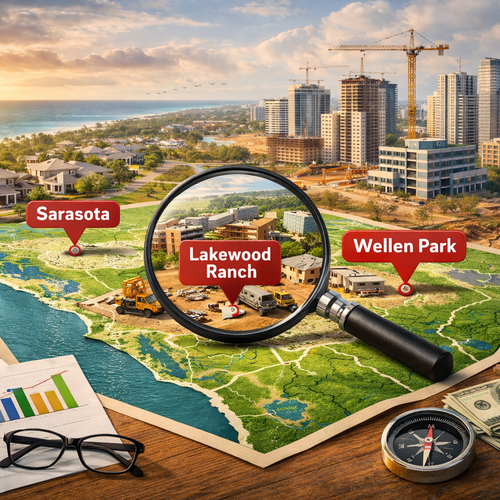



If you are researching Lakewood Ranch, Florida right now, there is a very good chance you have come across a community called Star Farms.
It is one of the newer and more talked-about villages inside an already massive master-planned area, and it is getting a lot of attention for good reason. It was, by most accounts, the number one overall selling community in the area in 2025. You will hear people talk about the amenities, the builder mix, the lifestyle, the location, and the value. You will also hear criticisms about how far out it sits and questions about builder quality.
The reality is that all of those conversations have some truth to them.
Like most communities in Southwest Florida, Star Farms has both tradeoffs and strengths. Whether it makes sense for you depends on what you are looking for, where you are in life, and what matters most in your day-to-day routine. Star Farms is doing something a little different than many other neighborhoods. It is very much a pick-your-poison style community. It is large scale, multi-generational, and built around variety. You have more than five builders, housing that ranges from more affordable production homes to multi-million-dollar custom estates, and four separate amenity campuses inside what is essentially its own mini-town.
But as with anything in Sarasota or Lakewood Ranch, context matters.
Where it sits on a map matters. Who it is really designed for matters. And understanding how it fits into the bigger picture of both the region and your family is what ultimately determines whether it is a good fit.
So let’s break down Star Farms in three parts: where it sits, what it actually is, and where things stand in 2026 if you are considering buying here this year.
Where Is Star Farms?
To me, location is always the first question.
You can have the greatest community in the world, but if you do not like where it sits on a map, then everything else becomes pretty irrelevant.
Star Farms is one of the roughly 50-plus communities that make up Lakewood Ranch, Florida. Lakewood Ranch started as a northeast suburban offshoot of the greater Sarasota metro area in Southwest Florida. Today, it is much more than that. It has grown into its own major destination and its own full-scale part of town. In many cases, people now write Lakewood Ranch on their mailing address instead of Sarasota or Bradenton.
Because Lakewood Ranch is so large, location inside the Ranch is not all equal, especially in 2026.
There are communities within Lakewood Ranch that sit roughly 7 to 7.5 miles from downtown Sarasota. Since downtown Sarasota is itself coastal, that means you can be 12 to 15 minutes from downtown and only a few more miles from places like Lido Key, St. Armands Circle, and Siesta Key. That westward access is a big part of why so many people are drawn to this region in the first place.
Star Farms is not in that category.
Star Farms sits in the farther-out section of Lakewood Ranch. It is roughly 21.1 miles from downtown Sarasota, which realistically puts you around 37 to 40 minutes away, usually traveling through Fruitville depending on traffic.
Now, that comes with some perspective.
One of the nice things about Sarasota as a metro is that it is geographically narrow. You are not usually more than 25 miles from much of anything, and even when you are sitting in traffic here, it is not the same experience as sitting in dense concrete traffic in a place like New Jersey. You still have palm trees, open sky, bridges, and water. So for many people, the distance may not feel like a dealbreaker.
But it is also not nothing.
That distance applies not just to downtown Sarasota, but also to the main hubs inside Lakewood Ranch itself. One of the major benefits of a master-planned area is that residents across multiple neighborhoods can share lifestyle centers, shopping districts, parks, restaurants, and communal spaces that make daily life easier without always needing to go into the city.
The catch is that most of Lakewood Ranch’s main hubs also sit farther south and southwest.
That means if you live in Star Farms, you are not only about 40 minutes from downtown Sarasota, you are also around 10 miles from many of the most popular lifestyle centers within Lakewood Ranch. Places like Waterside Place, Lakewood Ranch Main Street, University Town Center, and newer retail hubs like Fruitville Commons are not right next door.
Instead of a three- or four-minute golf cart ride, you are more realistically looking at an 18- to 20-minute drive from Star Farms to many of your own suburban amenities.
That framing matters.
Most people would naturally prefer to be closer to the action if all things were equal. But the reason people still choose a place like Star Farms is because they are usually gaining something in exchange. That might mean lower cost for a newer home, larger floor plans, bigger lots, more surrounding space, or a much more robust amenity package inside the neighborhood itself.
And that is really the key with Star Farms: you need to evaluate it based on its own internal lifestyle.
Unlike some communities where the outside surroundings are the main attraction, Star Farms is designed to create a lot of that lifestyle internally. It is essentially a master-planned suburb inside a master-planned suburb.
Depending on your life stage, that can be a very strong fit.
This area sits close to some of the most family-oriented infrastructure in all of Lakewood Ranch. You have the Premier Sports Campus nearby, which hosts large regional tournaments and sporting events. You also have the Lakewood Ranch Aquatic Center, the newer state-of-the-art library, Lake Manatee School, and a brand-new high school being built in the area. There are parks, playgrounds, recreational spaces, and a corridor that is heavily geared toward what families do every day.
So while you absolutely want to understand the location conversation, the point is not that it is good or bad. The point is that it is intentionally different, and you want your decision to be intentional too.
What Is Star Farms?
At its core, Star Farms sees itself as its own hometown.
It is described as a multi-generational lifestyle community, and that fits well within the broader identity of Lakewood Ranch itself, which has been the top-selling multi-generational master-planned community in the country for years. Star Farms takes that idea and pushes it further.
The community sits on around 1,300 acres, is gated, and is planned for just under 3,000 homes when fully built out. Within that footprint, it offers a wide range of housing options. You will find single-family homes in several categories, paired villas, and townhomes as well.
That same theme of variety shows up throughout the entire neighborhood.
The Builders at Star Farms
The main builder presence here is D.R. Horton.
D.R. Horton is the largest homebuilder in America by volume, and their business model is very much based on scale. They standardize materials, floor plans, timelines, and construction processes. In exchange for that efficiency, buyers typically get more accessible pricing than they would with many other builders.
When people talk about D.R. Horton, they often frame it as a pure quality conversation. More often than not, though, it is really a business model conversation. They build homes at scale, and that allows them to hit price points many others cannot.
The reason they have such a strong presence here is not random. Their parent company, Forestar, is tied into the development side of Star Farms itself. That means they are heavily involved not just in building homes, but in the overall vision and development of the community.
Originally, Star Farms paired D.R. Horton with a smaller group of custom builders that have long histories in Lakewood Ranch, including Lee Wetherington, John Cannon, and Arthur Rutenberg.
That created an interesting mix from the beginning.
On one side, you had D.R. Horton product at more accessible price points. On the other, you had buyers building multi-million-dollar custom homes on large lots. At first glance, that seemed unusual to some people. But through the lens of lifestyle, it makes more sense. Someone may love the amenities, school district, and overall environment of Star Farms and still want a very high-end custom home. The community was designed to accommodate that range.
Then a middle layer emerged, and that is where Homes by WestBay came in.
WestBay fills the space between a volume builder and a full custom builder. Their homes offer a semi-custom feel, larger floor plans, and more upgraded design without going all the way into the full luxury custom category. They filled an important gap in the market, and their sales reflected that.
More recently, Perry Homes has entered the conversation. Perry is a builder that has been more familiar in markets like Texas, but they now appear to be making a push into Southwest Florida. As their presence grows, they may occupy a very similar lane to WestBay and continue to provide more of that middle-ground option as availability shifts.
So once again, you see the same pattern: different builders, different styles, different price points, and different buyer profiles all inside the same village.
That variety matters.
You have lot sizes ranging from around 50 feet to more than 90 feet wide. You have homes ranging from roughly 1,500 square feet to 5,000 or 6,000 square feet. Whether someone wants a low-maintenance option, a mid-size move-up home, or a large estate, Star Farms offers multiple ways to get there.
The Amenities at Star Farms
For many people, the amenities are what put Star Farms on the map.
This is not a community with one central clubhouse and one pool. Star Farms is built around four separate amenity campuses, and they are intentionally designed to serve different parts of the community and different lifestyles.
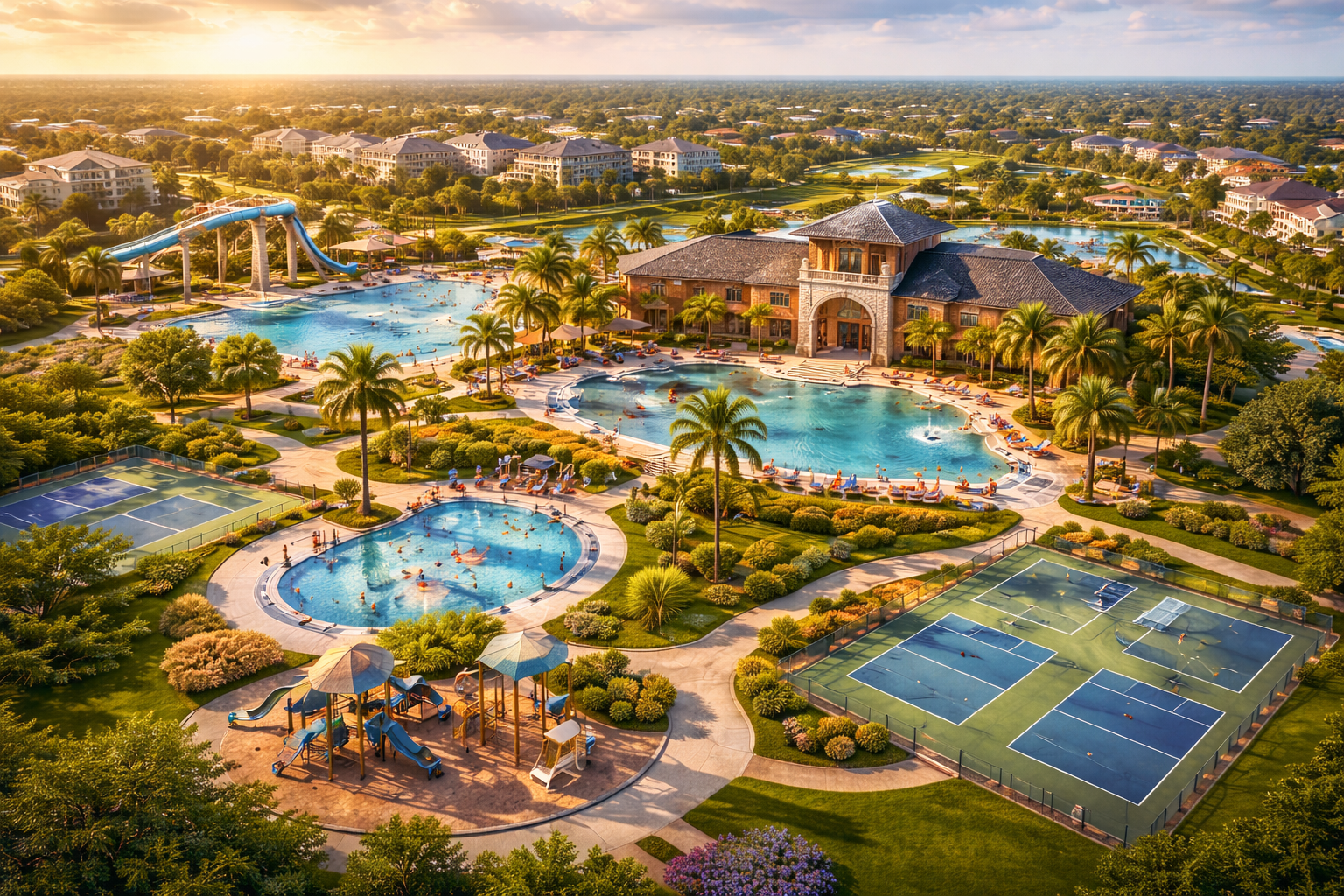
The first is the Resort Club, which functions as the central social hub. It includes a resort-style pool, clubhouse, fitness center, dining element, gathering spaces, and Trade Route Coffee, which has become one of the signature lifestyle features people associate with the community.
The second is Junction Place, which leans more family-oriented. This is where you find playgrounds, sports fields, sports courts, open play spaces, and activities geared toward younger residents and active families.
The third is Adventure Retreat, which is more focused on active adults. There is a 55-plus component in Star Farms, and this amenity area is built around wellness, fitness, gathering spaces, quieter programming, and a more relaxed environment without disconnecting residents from the larger community.
The fourth is Cabana Corner, which is more casual and social. It includes another resort-style pool, shaded lounge areas, and outdoor gathering spaces that give residents another option depending on what kind of environment they want that day.
Layered around all of that are greenways, walking and biking trails, open spaces, and parks. It creates what you could call a layered amenity system, which is very much in line with how Lakewood Ranch itself has evolved. Rather than one central experience for everyone, there are multiple spaces designed to serve different kinds of daily life.
There is also full-time lifestyle management on site.
That means the community experience is not just about maintaining amenities. It also includes active programming: clubs, events, social gatherings, fitness schedules, and the kind of concierge-style planning that helps make the neighborhood feel alive rather than static.
When you zoom out, Star Farms reflects a broader direction in Lakewood Ranch. Bigger lifestyle packaging, more builder variety, wider price segmentation, and more layered living environments are becoming part of the identity of the Ranch.
And there is a strong market signal that this concept is working. According to the developers, Star Farms was the number one selling community among actively building neighborhoods in Lakewood Ranch in 2025. A lot of different buyers did a lot of research and ultimately chose to spend their money here. That is not an insignificant signal.
Where Does Star Farms Stand in 2026?
As of the time this breakdown was recorded, D.R. Horton had sold roughly 75% of their homes in Star Farms as it exists today.
That still left 362 homes available in some form, with 52 of those being actively built spec homes.
Spec homes are worth understanding because not everyone is familiar with the term. In a traditional build-to-order process, you choose your lot, pick from the floor plans that fit that lot, choose design selections, and decide on structural upgrades. A spec home is different. The builder has already made those decisions and is building the home regardless of whether you show up or not. That often means you are buying it more like a resale home than a full build-from-scratch process, and it may be three to six months from completion rather than eight to twelve months away.
With D.R. Horton especially, that can be useful because their process is already more streamlined and option-light than many others. Their spec homes are often not materially different from what many buyers would have selected themselves.
The Big Next Phase: Saddlestone
One of the most important things to understand about Star Farms is that the story does not stop at Star Farms.
Right next to it is a community called Saddlestone. On many maps it may look like just another separate neighborhood, but in practice it feels more like a continuation of the same broader concept. Think of it almost like Star Farms 2.
Saddlestone is expected to add roughly 1,300 more homes, with around 1,000 of those tied to D.R. Horton. That gives buyers a much longer runway of opportunity, likely extending two to three more years depending on absorption and release schedules.
And it is not just more homes.
Saddlestone is also expected to add four additional amenity centers. Combined with the four amenity campuses already in Star Farms, that brings the total to eight. From what is currently understood, residents across Star Farms and Saddlestone are expected to have access to roughly six of those eight amenities depending on where they live.
That is a major lifestyle proposition.
Rather than simply replicating the exact same amenities, the expectation is that the additional centers will expand the experience even further, potentially including things like a water park and other new elements. It starts to create something you see more often in large-scale Texas-style developments: a huge amenity ecosystem with reciprocal access and significant variety.
That kind of setup is either for you or it is not. But lack of options will not be the issue.
The Value Proposition of This Part of Lakewood Ranch
I tend to think of Lakewood Ranch in four major quadrants.
You have the southern Waterside area in Sarasota County. You have the original central section. You have the upper section that developed after that. And then you have the northeastern/outer quadrant where Star Farms sits alongside places like Sweetwater, Lorraine Lakes, Del Webb Catalina, Palm Grove, and others.
That fourth quadrant is important because it tends to offer some of the lowest price per square foot in Lakewood Ranch while also being among the newest and fastest-selling sections.
Star Farms itself has been one of the fastest-selling individual neighborhoods in the Ranch. Much of that comes down to value. D.R. Horton has offered some of the largest homes for the money, lower price per square foot, and one of the lower HOA structures relative to the amenity package you receive.
That is a major part of the appeal.
If you are looking in March 2026 and trying to understand what makes Star Farms compelling, that is probably the first thing to understand: a lot of people are willing to trade some location convenience for newer homes, bigger homes, more amenities, and stronger value.
WestBay vs. Perry Homes
Beyond D.R. Horton and Saddlestone, one of the most important buyer decisions right now is the comparison between Homes by WestBay and Perry Homes.
These are the builders that sit in the next tier up from D.R. Horton. They offer more design depth, more semi-custom feel, and larger home options without going fully into the custom luxury lane.
Homes by WestBay has already established itself here and has been building three different series.
Their smaller series is on 50- to 55-foot lots and starts in the high $500,000s. They also offer an Artisan series on 60-foot lots, which is a sweet spot for buyers wanting around 2,800 to 3,000 square feet with a three-car garage on a single-story plan. Then they build on 90-foot homesites, offering plans up to nearly 6,000 square feet, often with three-car garages and much larger layouts, ranging from around $1 million to $3 million.
That gives WestBay an enormous range of floor plans and a lot of flexibility for buyers. One thing that stands out here is the availability of 90-foot homesites. That may not sound massive depending on where you are moving from, but in newer Southwest Florida suburban development, that kind of width is not common.
Then you have Perry Homes.
Perry is building on 50-foot lots starting around the mid-$700,000s, 60-foot lots starting around the mid-$800,000s, and 90-foot lots starting around $1.3 million. In many ways, I think they will compete directly with WestBay more than they will with any other builder in the community.
What makes that interesting is not just price. It is style.
Perry may bring design elements that feel a bit different from traditional Florida product. In other markets, they are known for modern finishes, built-ins, architectural features, and a style language that could stand out here. That gives buyers another layer of optionality. If WestBay and Perry are relatively close in price, then style, floor plan, street placement, and lot assignment start becoming the deciding factors.
That matters, because in this kind of community you do not simply pick any lot and then assign your preferred builder to it. Builders control specific lots in specific sections. So your decision often comes down to which builder has the floor plan you prefer on the lot or street you like best.
From a buyer standpoint, having WestBay and Perry sell against each other is a good thing.
If Perry follows a similar strategy to what WestBay did when entering the market, they may come in aggressively to establish a foothold. In markets where they are less known, that can create early opportunities around incentives and value. If that happens here, getting in early with Perry could be one of the more interesting plays in Star Farms over the near term.
And as Star Farms matures, much of that same conversation is likely to spill over into Saddlestone as well.
Final Thoughts on Star Farms
Star Farms is one of the clearest examples of where Lakewood Ranch is heading.
It is bigger, more layered, more lifestyle-driven, and more segmented than many of the communities that came before it. It is not trying to be for one type of buyer. It is intentionally built to serve multiple life stages, multiple budgets, and multiple housing preferences inside one very large village concept.
That is exactly why it is attractive to so many people.
But it also comes with tradeoffs, and the biggest one is location. You are farther from downtown Sarasota. You are farther from many of the core Lakewood Ranch hubs. And depending on your lifestyle, that may or may not matter.
If you are someone who wants to be closer to the coast, closer to downtown, or closer to the lower Ranch amenities, Star Farms may feel too far.
If, on the other hand, you care more about newer homes, more square footage, robust amenities, family-oriented infrastructure, and overall value, Star Farms can make a lot of sense.
That is really the point.
This is not a universally right or wrong community. It is a highly specific one. But if what it does well lines up with what you want, it is one of the more compelling options in Lakewood Ranch right now.
Check out this article next