


Parrish, Florida is one of the fastest-growing areas in all of Southwest Florida right now — and it’s not even close.
But here’s the thing most people miss early on:
Parrish is not Sarasota.
It’s not a beach town.
And it’s not trying to be.
Homes here routinely sell for $100,000+ less than nearby Sarasota, and that price gap has far less to do with quality than it does with lifestyle, location, and expectations.
In this article, I want to walk you through:
Who Parrish is actually a great fit for in 2026
Who should probably look elsewhere
And why a lot of smart buyers are taking a serious look at this area heading into the next year
👉 Quick note before we dive in:
If you’re considering a move here, I’ve put together a brand-new 2026 Parrish, Florida Relocation Guide. It breaks down communities, pricing, lifestyle trade-offs, and how Parrish fits into the greater Sarasota–Tampa Bay area.
First Things First: What Parrish Actually Is (And Isn’t)
Most disappointment I see around Parrish comes from people expecting it to be something it was never meant to be.
At its core, Parrish is a value-to-location play.
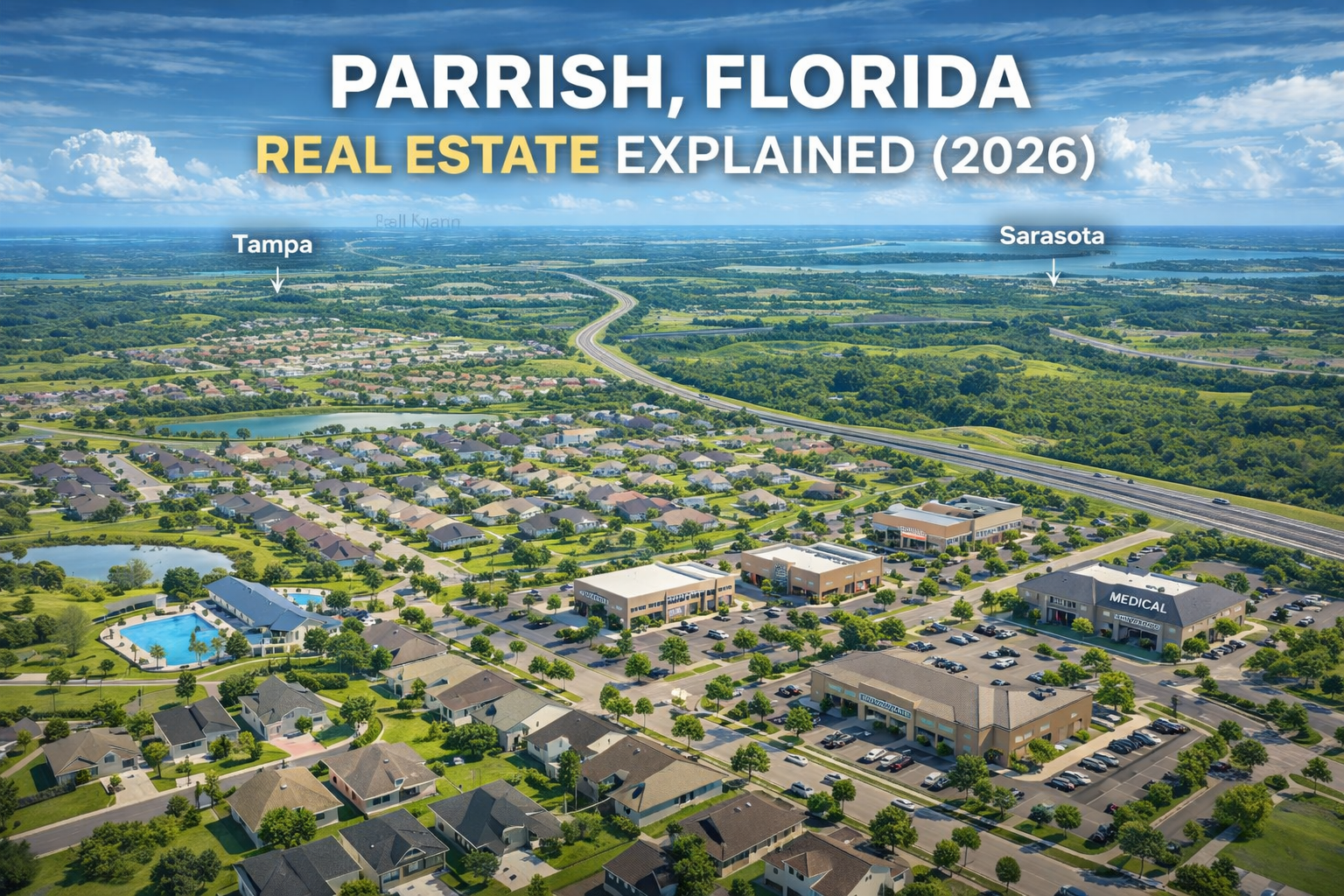
It sits between Tampa, Sarasota, Bradenton, and Lakewood Ranch, and that positioning matters more than most people realize. What it offers instead of coastal charm is space, newer construction, and regional access.
What Parrish is not:
It’s not a beach town
It’s not traditionally walkable
It’s not competing with Sarasota’s historic downtown or coastal lifestyle
Parrish is primarily a new-construction, master-planned community market. That usually means:
Newer homes
Larger floor plans
More predictable neighborhoods
HOAs (and sometimes CDDs, depending on the community)
Historically, Parrish has been a drive-to lifestyle:
You drive to the beach
You drive to downtown Sarasota or Tampa
You drive to most entertainment and dining
That’s starting to change — but it’s important to understand how it’s changing.
What’s being built now isn’t a historic downtown. It’s suburban commercial infrastructure: town-center retail, restaurants, medical offices, and everyday conveniences designed to support rapid growth.
That distinction is exactly why pricing is lower here.
You’re trading immediate coastal access and walkability for space, value, and regional flexibility.
And when you hear someone say “Parrish is amazing” and someone else say “Parrish isn’t for me” — they’re usually both right. They’re just judging it against different expectations.
Who Parrish, Florida Is Actually Great For (2026)
This isn’t theory — it’s based on real buyer behavior I see every week.
1. Families Who Want Space, Newer Homes, and Amenities
If you want:
A newer home
More square footage
A yard and garage
Neighborhood pools, playgrounds, sidewalks, events
Parrish checks a lot of boxes.
For many families, the value proposition is hard to ignore. You’re often getting significantly more home for the money than anything closer to the coast.
You’re trading location prestige for livability and flexibility — and for the right buyer, that’s a very smart trade.
2. Commuters & Young Professionals with Regional Flexibility
Parrish works surprisingly well for people who aren’t tied to one single downtown.
You can realistically access:
Tampa
St. Petersburg
Bradenton
Lakewood Ranch
Sarasota
It’s also a strong setup for frequent travelers:
Roughly 40 minutes to Tampa International Airport
Easy access to SRQ and Clearwater
If you fly regularly, you can leverage lower housing costs without sacrificing airport access — something that’s much harder to do in Sarasota proper or South Tampa.
3. 55+ Buyers Who Want Newer, Low-Maintenance Living
For buyers who want:
New construction
Lower maintenance
A community environment
And are okay driving a bit farther for beaches and culture
Parrish can be very compelling in 2026.
You’re avoiding the coastal premium while still getting modern homes, space, and improving convenience — without paying for a fully mature market.
4. Value-Driven Buyers Comfortable Being a Little Early
This is one of the most overlooked buyer profiles.
If you’re comfortable buying while an area is still filling in, Parrish offers opportunity:
Retail and services are expanding
Medical and infrastructure are catching up
Convenience is improving year over year
Many buyers here are thinking in 3–5 year windows, not because things are unfinished — but because they understand how growth cycles work.
Who Parrish Is NOT a Good Fit For
This is where people save the most time.
1. Buyers Wanting a Polished, Established Suburb Today
If you want something that already feels like:
Lakewood Ranch
Or a fully mature, prestige suburb
Parrish may feel early.
It doesn’t operate as one unified, finished place yet. It feels more like a collection of well-planned communities rather than a single, refined destination.
I often compare it to Wesley Chapel 10–15 years ago — growing, evolving, still defining itself.
2. Buyers Who Want Daily Coastal Living
If your vision of Florida includes:
Regular beach access
Coastal energy built into weekly life
Spontaneous sunset walks
Parrish is likely too inland.
Yes, you can drive to the beach — but it’s not the same as living near it.
3. Buyers Who Prioritize Walkability, Culture, and Nightlife
Even with new development coming, what’s being built is suburban convenience, not a historic or cultural downtown.
If walking to coffee, strolling to dinner, and built-in nightlife are non-negotiable, Parrish will likely fall short.
Why Parrish Is Often $100K+ Less Than Sarasota
This is where things really click.
As of recently:
Parrish median home price: ~$400,000
Lakewood Ranch: ~$620,000
Sarasota: ~$565,000
Parrish isn’t cheaper because something is “wrong.”
It’s cheaper because of what you’re paying for — and what you’re not.
You’re often looking at:
The same builders
Similar floor plans
Comparable finishes
The difference is you’re not paying for:
Coastal proximity
Walkability
A fully mature suburb
Once that clicks, deciding whether Parrish makes sense becomes much easier.
What’s Next for Parrish? (And What Isn’t)
Parrish is still in a build-out and catch-up phase.
Homes came first.
People followed.
Now commercial, medical, schools, and infrastructure are catching up.
That’s normal.
What’s likely:
Improved convenience
More services close to home
A more complete feel
What’s not likely:
Parrish becoming Sarasota
A sudden coastal or walkable identity
Growth here is about functionality, not transformation.
Final Takeaway
Parrish isn’t a compromise if it fits your priorities.
But it is a compromise if you’re forcing it to be something it’s not.
Parrish makes sense if you value:
Newer homes
Space
Value
Regional access
It probably doesn’t if you prioritize:
Walkability
Daily coastal living
Established culture and maturity
The smartest move isn’t finding the “best” place in Florida — it’s finding the place that actually matches how you live.
Next Steps
If we haven’t met, my name is Adam Hancock. Thanks for spending your time here — and I’ll see you on the next one.
Check out this article next