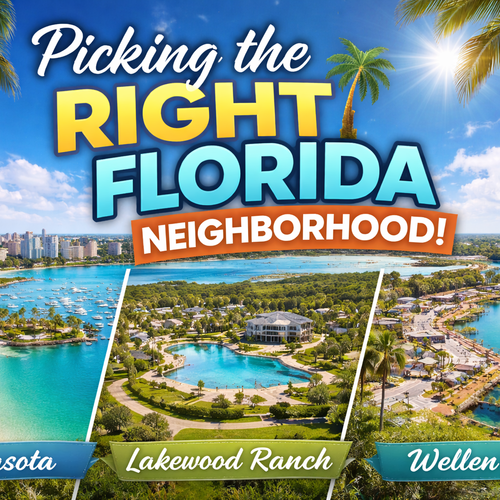



If you’re relocating across the country and looking at the Sarasota, Florida greater metro, one of the hardest parts of the entire process isn’t actually choosing the house. It’s understanding the shape of the market.
When you’re not local, everything looks flat. You see dots on a map. You see prices on a screen. You see a bunch of neighborhood names that don’t really mean anything to you contextually. And you’re expected to somehow turn all of that into an intelligent, confident decision.
So for this breakdown, I want you to imagine something different.
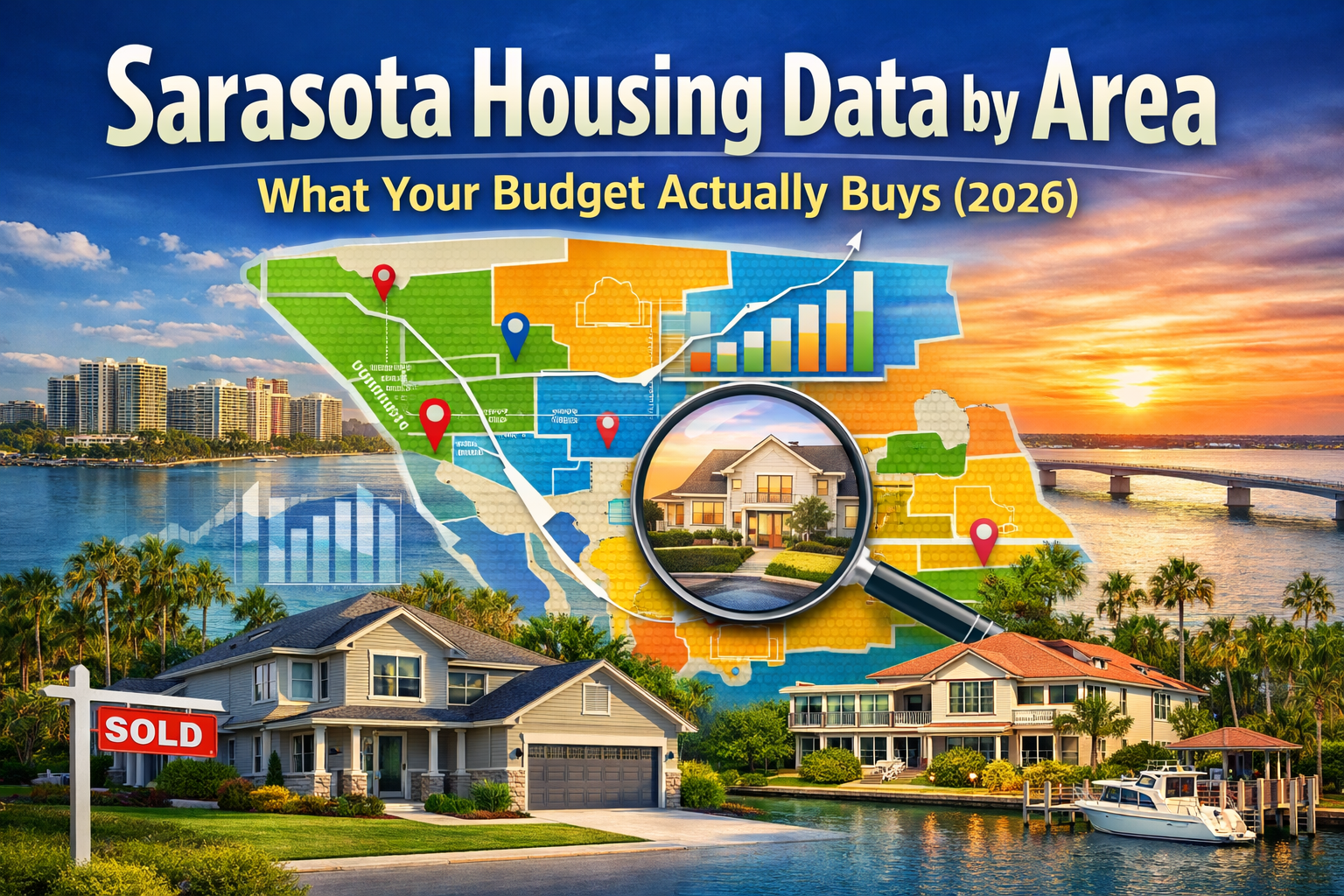
Imagine there’s a big map on the wall. It’s all of Sarasota and Manatee County — the entire metro — and we’re standing in the same room looking at it together. This is not a listing map. It’s not a neighborhood hype map. It’s a map broken into zones based on how people actually live and buy here.
Most importantly, it’s based on the median way people live — not the outliers.
That median idea is crucial. Every zone in this market has a cheap townhouse next to a $3 million house in the same zip code. That kind of data skew doesn’t help you. What helps you is knowing:
If I buy a normal house here — the one with multiple options, the one that isn’t weird or awkward — what does that look like, and what does it cost?
Everything in this analysis is backed by roughly 760+ days of closed MLS data — over 41,000 records that I manually pulled, cleaned, deduplicated, and grouped. There isn’t a report that gives you this. There isn’t a button for this. The zones themselves aren’t random. They’re based on pricing behavior, housing stock, proximity, and how buyers actually cross-shop the Sarasota metro.
Understanding the Shape of the Sarasota Metro
When you zoom all the way out and look at Sarasota as a whole, pricing does not radiate evenly from downtown or from the beaches. It clusters.
There are regions where money goes further, regions where it compresses quickly, and regions where the rules change entirely.
The fastest way to understand the entire market in one swoop is to anchor yourself to the highest-volume zone — because volume tells you where buyers feel most comfortable committing.
In this data set, that zone is Lakewood Ranch, Florida.
Lakewood Ranch: The Market’s Volume Anchor
Lakewood Ranch is the highest-selling zone in the entire data set. More homes have closed here than anywhere else over the last two-plus years, and that tells you something important: this is where buyers land when they want the process to feel manageable.
The median sale price in Lakewood Ranch sits in the low-to-mid $600,000s, with a medium price per square foot in the $200s. That combination matters. This isn’t cheap housing — it’s efficient.
Most buyers here are getting roughly 2,000 to 2,500 square feet in neighborhoods that feel finished and predictable.
Geographically, Lakewood Ranch sits northeast of downtown Sarasota and the beaches, and it’s big. You can be 25 minutes from downtown in one part of Lakewood Ranch and 45 minutes away in another — and still be in the same suburb. That distance is the trade-off.
What you get in return is certainty: multiple town centers, clear HOA structures, and neighborhoods that make sense without having to decode them.
Internally, there’s nuance. The southern end feels a little closer to town and a bit more established. The original middle section is the heart of the community. The northern side stretches further east and west and feels newer, trading distance for freshness.
What’s interesting in the data is how buyers stretch here. They don’t stretch to get into Lakewood Ranch — the median already supports that. They stretch within it. They move north for newer construction or inward for a better neighborhood.
If someone says, “I have a high-six or low-seven budget and I want something turnkey,” the data says Lakewood Ranch is one of the few places in the entire metro where that idea works cleanly.
Keep that in mind, because much of the rest of the metro is defined in contrast to Lakewood Ranch.
Wellen Park: Certainty With a Coastal Bias
If you go to the opposite end of the metro — geographically and philosophically — you end up in Wellen Park, south of Venice Island.
Pricing here generally sits meaningfully below Lakewood Ranch once you remove outliers. Price per square foot reflects newer homes, tighter footprints, and closer coastal proximity. It’s very difficult to be more than 18–20 minutes from the beaches in this zone.
You still get a master-planned environment. You still get recognizable builders, amenities, and a downtown component — but it’s more boutique.
If Lakewood Ranch is scale and certainty, Wellen Park is certainty with a coastal bias.
What’s interesting is that many buyers don’t consciously choose between these two. They eliminate one and fall into the other. If Lakewood Ranch feels too far north or too suburban, they go south. If Wellen Park feels too far south or too removed from Sarasota, they go north.
These two zones bookend the new-construction decision tree in this market.
Central Sarasota East of I-75: The Compromise Zone
For buyers who want new construction but don’t want to commit to either Lakewood Ranch or Wellen Park, there’s a third zone: Central Sarasota east of I-75.
This zone exists because the west is already built out. The median sale price here sits in the mid-to-low $600,000s, with price per square foot reflecting the possibility of larger homes and parcels.
You’re central, but you’re trading immediacy for space. You’re driving everywhere. This zone attracts buyers who want newer homes and gated communities but don’t need the identity of a master-planned ecosystem.
Together, Lakewood Ranch, Wellen Park, and Central Sarasota East explain most of the new-construction logic across the metro.
Central Sarasota West of I-75: The Resale Gravity Well
Most buyers don’t actually buy new construction. They buy resale.
The largest resale gravity well in the region is Central Sarasota west of I-75. Many relocation buyers land here — even if they didn’t start here.
The median sale price sits in the low-to-mid $400,000s. Price per square foot reflects older housing stock from the 1970s, 80s, and 90s. It’s block by block. Renovations matter and are inconsistent.
What you’re buying here is proximity: three to eight miles from downtown, the beaches, hospitals, and the places people are romantic about. The trade-off is age and inconsistency — but this is where mid-range budgets gain leverage by buying location instead of perfection.
South Sarasota West & the Venice Buffer Zones
Just south of Central Sarasota West is South Sarasota West, where median pricing sits in the mid-$500,000s. This reflects closer beach proximity and south-county access, but it’s still primarily resale.
South of Sarasota city limits — but north of Venice Island — is an important in-between zone. Median pricing here sits in the mid-$400,000s to low $500,000s. You’re buying balance: reasonable access to both Siesta Key and Venice beaches without committing fully north or south.
Buyers choose this area for optionality rather than structure.
North & South Extremes: Bradenton, Englewood, and Affordability Anchors
When downtown and beach-core pricing doesn’t work, buyers often jump far north or far south.
To the north, western Bradenton and Manatee River-adjacent areas offer median pricing in the mid-to-high $300,000s. It’s one of the cheapest ways to gain coastal proximity, but housing stock is fragmented and neighborhoods change quickly.
To the south, Englewood becomes a laid-back, relatively affordable coastal alternative. Median pricing sits in the low-to-mid $400,000s, but you’re buying calm and water access — not centrality.
Further inland, North Port, along with Parrish and Palmetto, anchor the affordability side of the metro. Median pricing typically sits from the high $200,000s to low $400,000s, depending on location. You’re buying cost control, flexibility, and volume — not polish.
Downtown Sarasota & the Barrier Islands: Where the Rules Change
Once you cross into downtown Sarasota, west of the Trail, and the barrier islands, the conversation changes entirely.
You can’t talk about price without separating condominiums from single-family homes. Median pricing pushes well north of seven figures quickly. Price per square foot decouples from logic, and scarcity overrides efficiency.
People don’t buy here because it’s efficient. They buy here because they want it.
Downtown Sarasota, Lido Key, Bird Key, Siesta Key, Longboat Key, Anna Maria Island — different vibes, same rule.
The Framework That Matters
Once you understand all of this, the metro doesn’t feel random anymore. It becomes a map of trade-offs.
Your budget doesn’t choose your house.
Your budget chooses which version of the Sarasota metro you’re able to participate in — and how much compromise you’re willing to make to do so.
If you’re trying to apply this framework to your specific budget and priorities, that’s exactly the type of conversation I built my brokerage around. Personalizing this — asking questions, querying the model — is where clarity really happens.
If we haven’t met, my name is Adam Hancock. If I can help you in any way, please consider reaching out.
Check out this article next