


If you are looking at moving to an urban core anywhere in the state of Florida, let’s use downtown Sarasota as an example, there’s something really interesting that happens structurally if the suburbs aren’t relevant to you.
If you don’t want the master-planned communities, and you don’t want to be 20 or 30 minutes away from the culture, the restaurants, the water, and everything that comes with that, and you say, “I want to live in the action. I want to live in the thick of it,” the options narrow very quickly.
On the one side, you have vertical living: high-rise condominiums, the towers. In an urban core, especially coastal Florida, land is just limited. If developers want the premium locations, the water views, and the walkability, they do not use width to do that. They use height. That is just the economic reality of how it is done, and that is how they maximize the land value.
So urban Florida becomes vertical by nature as a byproduct of that.
On the other side, if you do not choose a high-rise, your only real alternative is usually what was already there. It is the original housing stock. In downtown Sarasota, that means 1950s, 1960s, maybe 1970s if you are lucky, single-family homes. They are on smaller lots, older construction, charming in many cases and quaint, but they are still aging.
And the data actually supports that.
Over the last two years in downtown Sarasota, about 70-plus percent of all sales were condominiums. Roughly a quarter were single-family homes, and that left the true townhome product, as it is classified, at around 2 to 3 percent of the entire market.
Even more interesting, the median year built for single-family homes hovered around the mid-1960s. Condos were in the early 2000s. There is an onslaught of newer stuff that has not been registered yet, but the few townhome products that sold in that data set were around 2017.
So what does all that tell us?
It tells us the urban core is structurally polarized. You are either buying vertical density, or you are buying older horizontal housing.
And that creates a lifestyle gap.
There is a very real group of buyers who want walkability. They want urban energy. They want the low-maintenance, lock-and-leave convenience. But at the same time, they do not necessarily want high-rise elevators. They do not want stacked units. They do not want HOA dynamics that come with towers and 20 floors of shared infrastructure.
At the same time, they also do not necessarily want to take on a 1965 house with older systems and ongoing maintenance either.
So you end up with this question:
What if I want something that feels a lot closer to a single-family home, but I want it in a condominium location?
That is where I came up with this term: the missing middle.
This is where it starts to show up.
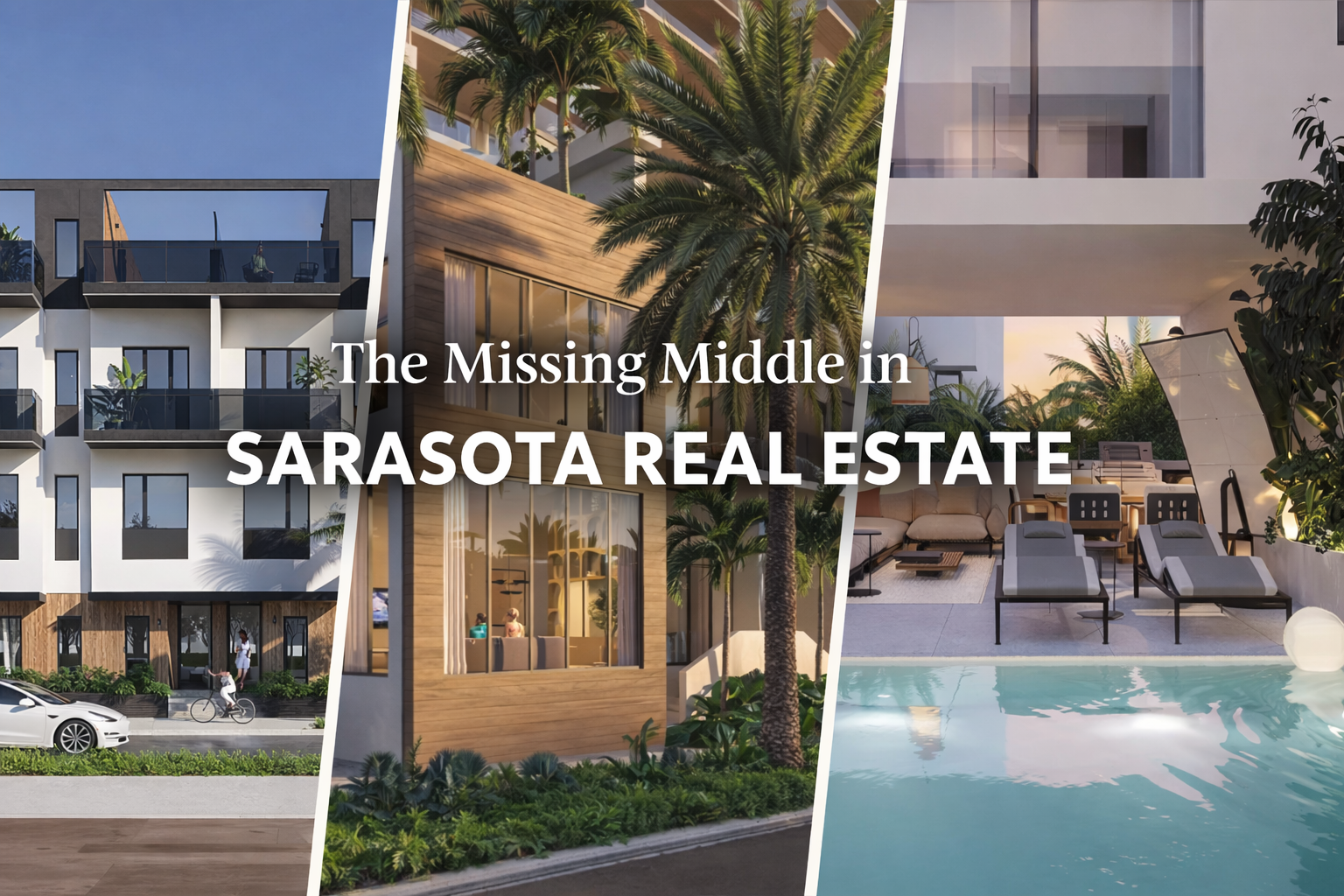
And I do not think this is random. I think this is developers responding to very real and recent demand. We are starting to see boutique infill projects — two to three stories, private garages, rooftop terraces, limited shared walls, small associations — but they are right inside the urban core.
They are technically attached, often legally classified as condominiums or townhomes, but they live very differently than the towers of the past.
They are trying to solve one core problem:
How do you give someone independence and privacy without giving up that location?
That is the bigger conversation here.
This really is not about architecture. It is about control.
Buyers moving to Florida, especially those relocating from out of state, want autonomy. They want proximity to culture, restaurants, and the water, but they do not necessarily want to feel like they are living vertically in a building with hundreds of neighbors.
At the same time, they do not want to go back to the full-scale suburban maintenance either.
So this emerging category — this missing middle — is essentially an attempt to balance independence with density.
And in downtown Sarasota, it is still small. Very small, honestly. But it is meaningful because it signals that the market recognizes this gap.
With that context in mind, here are a few really interesting projects that serve as examples of what this looks like in the real world, in real time, and who they are actually right for.
Rosemary Residences
The first one worth talking about is Rosemary Residences.
This is a really modern project, and visually it is a strong product. It has the kind of look that has been showing up more throughout Tampa Bay and St. Pete, and it translates well here.
Location-wise, Rosemary sits just a little off what most people would consider the ideal downtown Sarasota core. It is not materially far, but it is about a half mile away and crosses Fruitville Road. That divide is subtle, and there is definitely an eye-of-the-beholder element to it, but it does matter.
If you could pick one ideal pocket of downtown Sarasota, it is the area where you are right in range of the restaurants, the art, the culture, and the water. Rosemary is just a bit off that main zone, which is exactly why this kind of product can exist there. In many cases, developers simply do not have room to build something like this in the tightest part of downtown.
This project is priced roughly from $1.8 million to $2.5 million, with about 18 residences total. Delivery timing is also worth noting. In many cases, products like this can deliver a lot faster than the three-year timelines you often see with larger condominium projects.
What makes Rosemary interesting is how clearly it fits the missing middle concept.
You are getting:
two-car garages
rooftop terraces
no one above you
limited shared walls
a smaller association
a much more independent lifestyle than a tower
There are basically two offerings here.
The larger, more premium stack includes private elevators and expanded rooftop features. The more affordable stack still includes rooftop space, but at a lower entry point.
And this is exactly the kind of project that pitches itself against the same issues buyers are already wrestling with. The appeal is obvious:
no shared walls in the way people think of towers
lower HOA structure
lower cost of ownership compared to many high-rise luxury condos
the same general downtown conversation without fully giving up location
That matters, because a luxury high-rise condominium does not usually win on pure economics versus a suburban single-family home. It is typically more expensive in fees, more expensive in overall risk, and often more expensive on a per-square-foot basis.
What you are paying for is location.
That is the key.
And with a product like this, you are not losing the location in the same way you would by moving out to the suburbs, but the ownership experience may be simpler, and the resale equity could become very interesting from a scarcity perspective.
The floor plans reinforce that.
The more affordable units are around 2,800 square feet, with three bedrooms and three-and-a-half baths. The premium units climb to around 3,600 square feet, which is sizable for a downtown townhome product.
Another interesting detail: on the front units, owners can choose between a six-person hot tub on the roof or a cold plunge and sauna combination. That kind of feature set says a lot about who this product is targeting. It is not trying to compete with a suburban house. It is trying to offer a more private, design-forward version of urban living.
Orange One
Another project that fits this conversation well is Orange One.
Structurally and fee-wise, this one is going to be closer to a condominium. But the way it lives is not going to feel like a high-rise, which is why it belongs in this discussion.
There are three primary components here:
ten three-story condominium residences
ten retail condominium spaces underneath
ten three-story townhomes along Fourth Street tied into the larger complex
Location-wise, Orange One is very close to Rosemary Residences. Both sit just across Fruitville from the core downtown district, and both are part of the same broader push of development happening in that direction.
This is also a good moment to pause and remember what downtown Sarasota actually offers within a very tight radius.
Within about five blocks, you have roughly 65 restaurants, art galleries, theaters, the farmers market, and direct connectivity to some of the best waterfront and beach access in the state.
This part of Southwest Florida is often called the Cultural Coast because of the density of galleries, performance spaces, and arts-related amenities relative to the size of the city.
From downtown Sarasota, you have quick access to:
St. Armands Circle
Lido Key
Longboat Key
Siesta Key
downtown shopping and dining
the waterfront itself
That triangle of downtown Sarasota, St. Armands/Lido, and Siesta Key is one of the best location setups not just in Sarasota, but in Florida overall.
Back to Orange One.
This is a more premium offering than some of the others in the category. Every unit includes:
a private elevator
a private swimming pool
a guest house villa concept
a private two-car garage
outdoor kitchens
One of the most interesting design choices here is the separation between the main living space and what they call the guest house villa across the pool. It creates a treehouse-style effect where the secondary space can function as a guest suite, office, or flex space while remaining visually and functionally connected to the main home.
That layout does a really nice job of creating privacy and flexibility, while still feeling urban.
Again, this is what makes the missing middle so compelling. You are not just talking about square footage or architecture. You are talking about a different living experience entirely.
You are getting things that are difficult or impossible to replicate in a traditional high-rise, like your own pool, your own garage, your own segmented outdoor space, and a home that feels more personal.
One Park Townhomes
A third project that fits this conversation really well is One Park Townhomes.
This one is a nice blend of everything discussed so far because it sits between an up-and-coming infill play and full-on pre-construction condominium. It is much closer to the condo side, but it still offers something distinct.
The location is especially important here.
Where Rosemary and Orange One sit just outside the tightest downtown core, One Park sits within The Quay, a bayfront mixed-use district in a much more premium positioning.
The Quay is a 14-acre mixed-use waterfront district with strong Ritz-Carlton presence, newer towers, branded residences, luxury rental product, and major redevelopment momentum. It is one of the most important urban districts in Sarasota right now.
One Park itself is a new luxury building with high-end wellness amenities and a relatively limited unit count compared to larger towers. The townhomes connected to this project are what make it stand out.
These homes give you:
a private entrance
a private two-car garage
a private rooftop
a private plunge pool
access to the building’s full amenities because they are part of the same overall project
That is the real perk here.
This is not a discount product. This is a premium price point. But it gives you something that would be hard to find anywhere else.
It is a scarcity play.
One of the units discussed is around 3,100 square feet, configured as a two-bedroom, three-and-a-half-bath residence, with an owner’s suite that occupies a large portion of the second level. The rooftop itself is substantial — around 1,100 square feet — and includes the plunge pool.
So you are getting private residential features that normally are not available in a building, while also getting access to the kind of amenity package only a major condominium project can provide.
That includes things like:
a resort-style infinity-edge pool
a wellness spa
fitness center
Pilates, yoga, and cycling rooms
a private theater room
security
valet services
the full concierge-style experience
That combination is what makes it so unusual.
You come home to your townhome, but you still have access to the full building infrastructure.
And when you zoom out, that matters because downtown Sarasota has a few very specific urban living zones:
The Quay, which is the newer, bayfront luxury district
Golden Gate Point, a peninsula surrounded by water with its own collection of condominium product
the downtown core itself, where walkability and cultural access are strongest
select nearby niche locations like Bird Key or the barrier islands, which offer great lifestyle value but come with different tradeoffs
The closer you are to the true downtown core and the waterfront access points that connect everything, the more premium the location becomes.
That premium is not just about prestige. It is about optionality.
You are in between everything.
You have access to downtown, the shopping, the culture, and the bridges out to Siesta Key and Longboat Key. You are not overcommitted to the island lifestyle, and you are not pushed too far inland either.
That in-between positioning has real value.
Why This Category Matters
What makes all of this interesting is not just the product itself. It is the fact that this category is beginning to appear at all.
The suburbs are still valid for the heavy majority of the relocating population. That is still true.
But for people who want Sarasota for Sarasota reasons, there is a lot happening right now in the urban core that deserves attention.
There is also a serious information gap.
New construction single-family homes versus resale creates a similar challenge, but pre-construction urban product is even harder to track. It is hard to tell timing. It is hard to tell what is actually available. It is hard to know how many units exist, what the pricing looks like, what has not been publicly released yet, and how one project compares to another.
From the outside, it can look like there are a billion developments going on in the area, and on the internet, it is easy to feel like you are just guessing.
That is especially true in the pre-construction space because pricing is often not fully shared, inventory can move quietly, and the details are rarely centralized in a way that is useful for a serious buyer.
And beyond that, none of it means anything without context.
You need to know what to look at. Then once you look at it, you need to know what else you should compare it to. Then you need to know what you should be aware of, how to think about tradeoffs, and how to mitigate risk.
That is really the point of this whole conversation.
Final Thought
The missing middle in downtown Sarasota is still small, but it is real.
It is a meaningful sign that the market understands there is a buyer who wants:
walkability
urban energy
lower maintenance
more independence
more privacy
less vertical living
less suburban upkeep
That buyer has not had many options for a long time.
Now, slowly, that is changing.
And as downtown Sarasota evolves, this category may end up becoming one of the most interesting parts of the market — not because it is the biggest segment, but because it solves a very specific problem in a location where that problem has gone largely unanswered.
Check out this article next