


At first glance, this sounds like a negative topic.
And on YouTube, “where not to live” videos usually go one of two ways: either they’re overly dramatic, or they flatten every area into good versus bad. That’s not really helpful when you’re making a cross-country move.
The better way to approach this is to ask a different question:
Why do people consistently choose against certain parts of the Sarasota area?
Because when you understand that, two useful things happen.
First, you avoid making a decision that looks fine on paper but feels wrong once you’re living it day to day.
Second, you often get clarity on where you should be looking. One buyer’s dealbreaker is another buyer’s sweet spot. So by understanding the cons of one area, you usually get pushed more clearly toward the area that actually fits you.
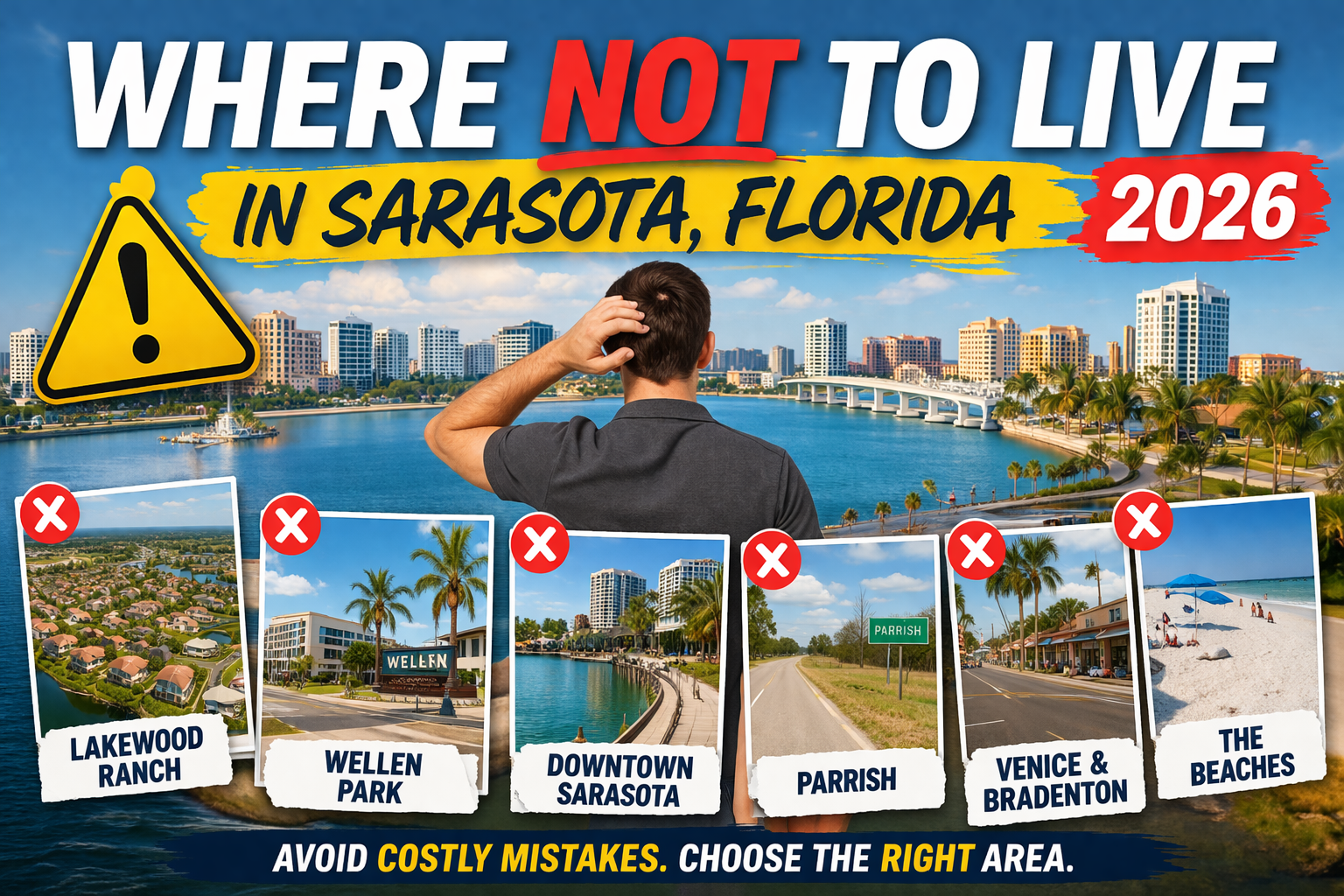
This article covers the main places buyers tend to rule out in and around the Sarasota metro in 2026 — not because they’re objectively bad, but because they tend to create friction for a lot of out-of-state movers.
1. Lakewood Ranch
Let’s start with the obvious one.
Lakewood Ranch is not just suburbia. It is the king of Florida suburbia.
This is not a place with five or six new neighborhoods clustered together. It is a massive, highly intentional, multi-generational master-planned community with 50+ neighborhoods, multiple town centers, extensive amenities, and a scale that really doesn’t have many peers in the state.
That’s exactly why so many people love it.
It’s also exactly why some people decide it’s not for them.
Why people rule it out
1. The scale can feel overwhelming
The same thing that makes Lakewood Ranch impressive can also make it feel like too much.
It is large. It is growing. It is busy. And in a region where east-west and north-south traffic patterns matter a lot, that scale has consequences.
If you’re someone who wants new construction, nice amenities, polished surroundings, and a suburban feel, Lakewood Ranch checks a lot of boxes. But some buyers get there and realize they do not need that level of size, density, and movement.
That’s where hesitation starts.
2. Distance to the coast is real
This is one of the oldest knocks on Lakewood Ranch, and it still matters.
Yes, you get more house, more newness, more planning, and more amenities.
But you are making a geography trade.
One section of Lakewood Ranch sits relatively close in, but much of the community stretches much farther east. That means your distance to downtown Sarasota and the beaches varies dramatically depending on which district you land in.
And in Sarasota, mileage is deceptive.
Seven to ten miles is not necessarily seven to ten minutes. For many parts of Lakewood Ranch, especially the more northern and eastern sections, what looks manageable on a map can become 40 to 50+ minute drives to the areas buyers initially thought they wanted to be near.
That may not bother you at all.
But for some people, there is a line where the trade-off stops feeling worth it.
3. Budget mismatch creates disappointment
Lakewood Ranch is also one of the easiest places for expectations to get out of sync with reality.
A buyer might come in with a solid budget — say $750,000 — and assume they can choose freely across the community.
That is not how it works.
At that price, one district might mean a villa. Another might mean an attached product. Another might mean a very different location or builder than what you originally envisioned.
So the friction is not just about affordability. It’s about the fact that your budget does not translate evenly across Lakewood Ranch.
That catches people off guard all the time.
4. It can feel too cookie-cutter
This is more of a style issue than a market issue, but it’s real.
A lot of new construction neighborhoods look polished because they are built quickly, with similar elevations, similar palettes, and similar interior selections. White kitchens, similar flooring, similar façades — the whole “Pleasantville” effect.
Some buyers love that.
Others walk in and think, “This has no character.”
If you want charm, architectural variety, or a more organic neighborhood feel, Lakewood Ranch may not be your place.
2. Wellen Park
Wellen Park is the other major peacock in the conversation.
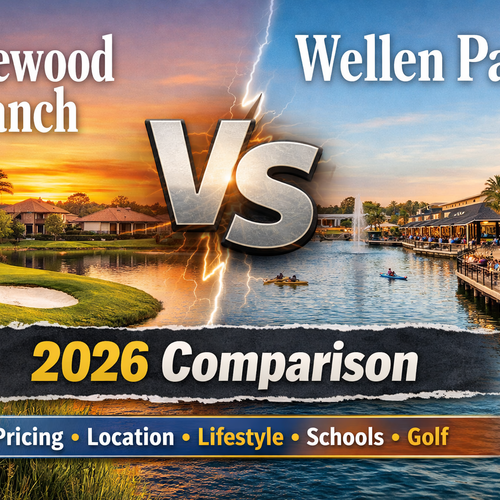
It gets compared to Lakewood Ranch constantly for a reason: both offer master-planned living, lots of new construction, multiple neighborhoods, amenities, and a more organized suburban experience than most of the surrounding market.
That said, it loses buyers for very different reasons.
Why people rule it out
1. It feels more isolated
This is one of the biggest things buyers notice in person.
Lakewood Ranch feels like a self-contained world. Wellen Park feels more like a pocket carved into a broader southern geography.
You drive through a lot more existing area to get to it. You feel the transition more. And because it sits farther south, many buyers perceive it as “away from the action,” even if that action isn’t necessarily what they’ll use day to day.
This is partly perception, partly geography, and partly history.
For people who grew up with Sarasota as the center of gravity, Venice always felt like the more laid-back, junior version. That bias still lingers in the market, even if it’s becoming less relevant for out-of-state buyers.
Still, you feel it when you get there.
2. It still feels transitional
Wellen Park has come a long way, but it still feels newer in a more uncertain way than Lakewood Ranch.
Lakewood Ranch has been building since the mid-1990s. Buyers generally understand what it is.
Wellen Park still carries more of the “what will this become?” energy.
That can feel exciting if you view growth as opportunity. But if you’re more risk-averse, it can feel like you’re betting on a future version of the place rather than buying into something fully proven.
That makes some buyers nervous.
3. The surrounding area feels less cohesive
This is important.
Lakewood Ranch was largely built out from open land, so much of what surrounds it is part of the same ecosystem.
Wellen Park is more of a master-planned infill story. It sits among older Florida housing patterns — modular homes, non-HOA boater neighborhoods, modest legacy housing, retirement-era communities, and more mixed development types.
That does not make it bad.
But it does make it feel less seamless.
Some buyers interpret that contrast as character. Others interpret it as inconsistency.
4. The beach preference is specific
One of Wellen Park’s biggest strengths is coastal access. It is hard to get very far from multiple beaches in that part of the map.
But the beaches themselves have a different feel.
Venice, Caspersen, Brohard, and Manasota Key are all appealing, but they tend to feel more laid-back, more nature-centered, and more old-Florida than the north-of-it alternatives.
If a buyer’s mental image of Sarasota living is really tied to Siesta Key, Lido, St. Armands, and that more active, polished coastal environment, Wellen Park may not satisfy the same emotional need.
So yes, Wellen has stronger beach proximity than Lakewood Ranch overall.
But not everyone wants those beaches.
3. Osprey, Nokomis, and North Venice
This is one of the most misunderstood parts of the Sarasota area.
These towns sit south of Sarasota proper, but north of Wellen Park. On paper, that sounds like a perfect middle ground. You keep more access to Sarasota while still being near Venice.
That’s exactly why some buyers look there.
But it’s also exactly why others move on quickly.
Why people rule it out
1. There’s not enough new construction
This is the biggest issue.
There is new construction in pockets. But there is not enough of it, and it is not connected in a strong master-planned way.
So if you’re the buyer who wants a clean, easy-to-understand suburban package with lots of options, this area can feel frustrating fast.
You’re often dealing with a scattered mix of communities, resale, and one-off developments rather than a cohesive ecosystem.
2. It has an identity problem
This is one of those areas that can almost disappear in the search process.
It does not have the clarity of Lakewood Ranch.
It does not have the strong emerging identity of Wellen Park.
And unless you know the market well, it can feel like something you simply pass through on the way from Sarasota to Venice.
That ambiguity makes it harder for out-of-state buyers to emotionally latch onto.
3. You are more at the mercy of resale
Because this isn’t a major master-planned environment, a lot of what you’re looking at is resale — and resale in a less cohesive area.
That creates more guesswork.
If you are buying from out of state and trying to make a high-confidence decision, that can be a tough sell.
Why this could change later
Long term, this area may become much more compelling.
There are major future development conversations tied to this corridor, including the broader Palmer Ranch East vision. If and when that materializes, this whole stretch could evolve into something much more organized and self-contained.
But that’s future value.
For most buyers making a decision in 2026, it is not here yet.
4. Inland Sarasota
When I say “Sarasota” here, I do not mean downtown Sarasota or the islands.
I mean the inland middle portion of Sarasota — east of the trail, west of I-75, below Bradenton, above Osprey, and mostly away from the waterfront glamour that gives the city its broader reputation.
This is where the “just live in Sarasota” advice gets more complicated.
Why people rule it out
1. It’s mostly resale
This is the simplest explanation.
The middle of Sarasota is largely built out. So if you’re here, you are mostly shopping older resale neighborhoods.
That means homes from the 1970s and 1980s, a patchwork of neighborhood styles, inconsistent updating, and less of the turnkey predictability buyers often want.
2. It can feel random
This is not a cohesive, easy-to-read area for someone who is not local.
You have pockets with strong identity, but the broader inland Sarasota map can feel random.
There are little enclaves, older golf communities, legacy neighborhoods, and areas with a lot of personality — but not a ton of packaging.
For a local, that can be interesting.
For an out-of-state buyer, it can feel confusing.
3. The new construction options are limited
There are some notable options like Skye Ranch or Grand Park, but once those don’t fit, the fallback is not usually “great, I have 15 more communities to compare.”
The fallback is resale.
That’s the major difference versus the big suburban peacocks.
Again, none of this means inland Sarasota is bad.
It just means it is not easy.
5. Parrish
Parrish is one of the clearest “trade-off” areas in the entire Southwest Florida conversation.
People usually land on Parrish by working backward from Lakewood Ranch.
They start in Lakewood Ranch, realize the budget or geography is not working the way they hoped, and then push farther north.
That’s the Parrish path.
Why people rule it out
1. It is far
That is the whole conversation.
Parrish is not just a little farther than Lakewood Ranch. It is materially farther.
So if a buyer already feels stretched by a 40-to-50-minute one-way relationship to the Sarasota core, adding more mileage can feel like too much.
2. It does not have the same cohesiveness
Parrish has a lot of new construction. In fact, it is one of the more active building zones in Southwest Florida.
But it is not being built in the same cohesive way as Lakewood Ranch.
You may have strong communities like North River Ranch and other appealing pockets, but they do not all tie together into one seamless, intentional-feeling place.
That difference matters when buyers get there in person.
3. It feels more country
For some people, that is a positive.
For most buyers comparing it against Lakewood Ranch, it feels like a concession.
The environment is less polished, less integrated, and more rural in feel. If you are already emotionally anchored to Sarasota living, this can feel like a bridge too far.
Why some people still choose it
The answer is value.
If Lakewood Ranch’s median is far above what you comfortably want to spend, and Parrish gives you more natural abundance at your budget, then the distance may start to feel acceptable.
Especially if you also like the idea of being closer to Tampa, Tampa International Airport, or even St. Petersburg access.
But for most buyers, Parrish is something they arrive at through compromise, not through original intent.
6. Western Bradenton
Western Bradenton is one of the trickiest map traps in the region.
On paper, it looks amazing.
You are near water. You are close to Anna Maria Island. St. Petersburg feels within reach. Downtown Bradenton has activity. The whole thing looks better on the map than the pricing sometimes suggests.
That alone creates curiosity.
Why people rule it out
1. It’s inconsistent
This is the main thing.
Western Bradenton is older, more patchy, more eclectic, and less turnkey than many buyers expect.
You have legacy homes, varying levels of upkeep, pockets of reinvestment, older infrastructure, and a much more mixed visual experience than you get in a newer master-planned environment.
That can feel interesting or frustrating depending on the buyer.
2. It’s harder to understand quickly
This is not an area where you can show up from out of state and instantly “get it.”
It takes more interpretation.
The neighborhoods do not all signal clearly. The quality shifts block to block more than some people are comfortable with. And unless you have a very specific reason to be there, a lot of buyers feel more confident elsewhere.
3. It’s not turnkey
This is a recurring theme throughout the article, but Western Bradenton really fits it.
If your priority is predictability, polish, and simplicity, this is usually not where you end up.
When it does make sense
It can work really well for buyers who want an eclectic, artsier, less packaged environment — or who have a strong location-based reason to be there.
A good example is IMG Academy. That alone pulls plenty of families and athletes into the area.
And from a price-to-water-access standpoint, Western Bradenton can still create interesting value if you understand what you’re buying.
7. Downtown Sarasota
Downtown Sarasota is one of the most desirable parts of the region.
It is beautiful, walkable, cultural, and uniquely tied into the waterfront.
But it is also one of the easiest places for buyers to romanticize without really understanding what day-to-day ownership looks like.
Why people rule it out
1. It is mostly condos
That is the headline.
Most of what sells in downtown Sarasota is condominium product. Single-family housing exists, but it is a much smaller piece of the market and tends to be older.
So if you love new single-family homes, gated neighborhoods, garages, and suburban predictability, this is not your lane.
2. You pay a premium for geography
Downtown Sarasota is not an “economics first” market.
It is a geography-first market.
You are paying more for less square footage because you are buying access — walkability, waterfront, dining, culture, and scarcity.
That makes total sense for the right buyer.
But it is not a casual choice. Condo fees, assessments, and the realities of vertical ownership all need to be part of the decision.
3. Inventory is competitive and limited
This is Sarasota’s cultural core.
Demand is always going to exist here. So even when the broader market shifts, downtown Sarasota holds a different kind of energy than more substitutable suburban product.
That scarcity and competition are part of the appeal.
They are also part of why many buyers decide it is not worth the complexity or the premium.
8. The Beaches and Barrier Islands
The Sarasota-area beaches are some of the most desirable in Florida.
That does not mean every beach lifestyle fits every buyer.
In fact, this is one of the clearest places where fantasy and reality can drift apart.
Siesta Key
Siesta Key is world-famous for a reason.
But the very things that make it exciting for visitors can make it feel hectic for full-time residents.
It is more tourist-driven, more active, more public, and more vacation-oriented than a lot of people realize. If you crave privacy, discretion, or a quieter residential feel, the energy can wear on you.
Lido Key
Lido is smaller, tighter, and much closer to downtown Sarasota.
That makes it incredibly appealing.
It also makes it scarcer, denser in its own way, and more tied to the St. Armands environment than some buyers want. It is one of those places where renting first makes a lot of sense before committing.
Longboat Key
Longboat feels more private and more residential than Siesta or Lido, which is exactly why some buyers prefer it.
But that privacy comes with trade-offs.
If you get too far north on the island, you are really out there. Great once you’re home, less convenient when you want to move in and out of town regularly.
Venice Island
Venice Island is one of the more affordable ways to live walkably near the beach on the Gulf Coast.
But it has a more laid-back, older-feeling, less polished atmosphere than some buyers expect.
If you want coastal charm and a slower rhythm, that can be a plus. If you want upscale energy, it may feel sleepy.
Manasota Key / Englewood
This is the southernmost, more isolated version of the same trade-off.
You are going farther to get more privacy, more separation, and in some cases more value.
But you are also giving up convenience, centrality, and in many cases a stronger sense of connection to the rest of the Sarasota lifestyle.
Final thoughts: “where not to live” is really about fit
The point of a video or blog like this is not to scare you off half the map.
It is to help you understand where buyers most often feel friction — and why.
Because the truth is, none of these places are universally wrong.
They are just wrong for certain people.
If you hate cookie-cutter suburbia, Lakewood Ranch may be your “do not live here” area.
If you want mature, polished planning and hate transitional growth, Wellen Park may not work.
If you need predictability, Western Bradenton may feel too patchy.
If you want a single-family new-construction lifestyle, downtown Sarasota is probably not the answer.
That is the whole point.
The better you understand the trade-offs, the easier it becomes to narrow your search and make a decision you will still feel good about two years from now.
If we haven’t met, my name is Adam Hancock. If you’re trying to figure out where you should be looking in and around Sarasota, there are more resources available through the newsletter, relocation guides, and the Florida Relo Inner Circle.
And if you need help sorting through the noise, that’s exactly the kind of thing we help buyers do every day.
Check out this article next