



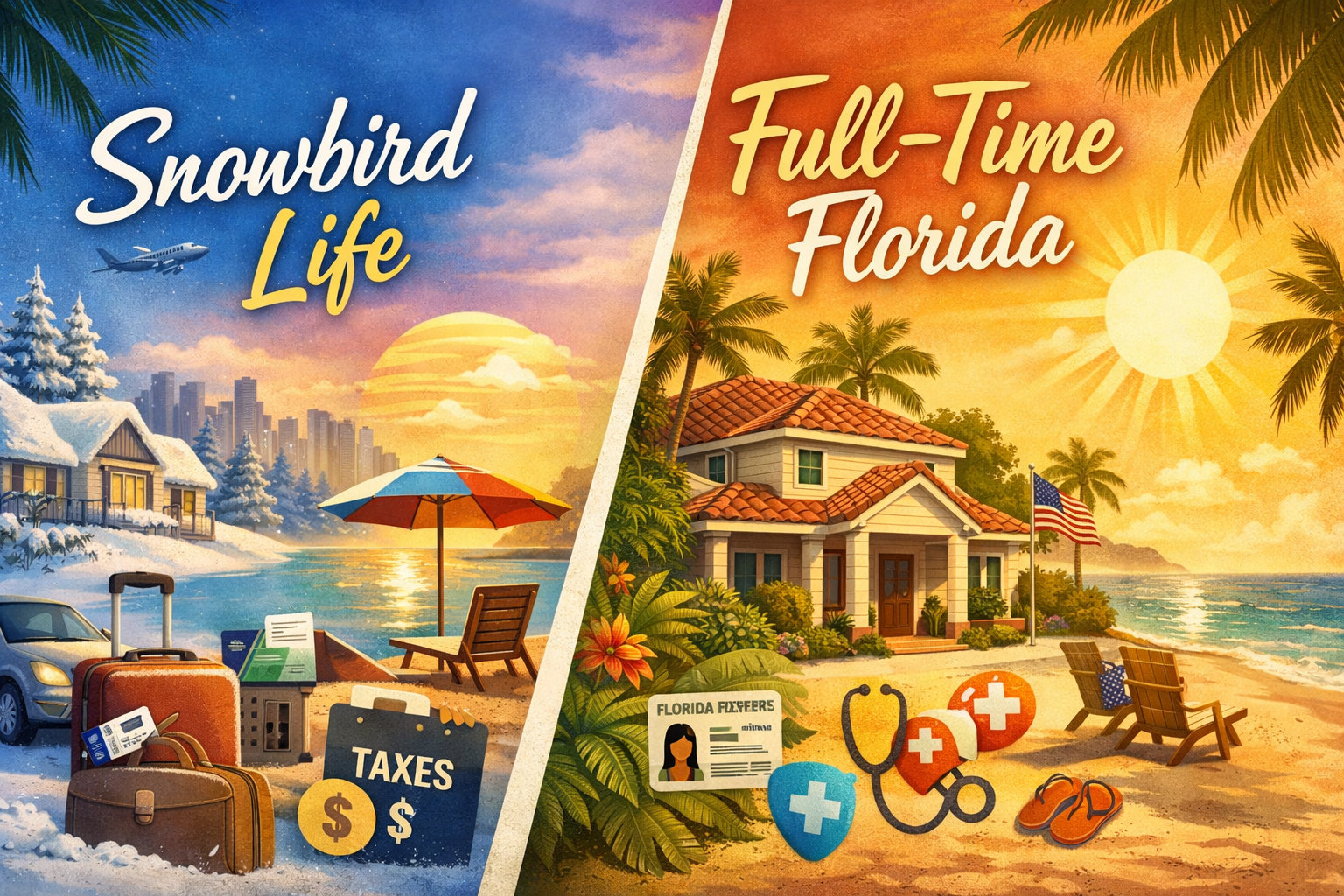
Should You Be a Florida Snowbird or a Full-Time Resident?
If you’re thinking about moving to Florida, there’s a decision that comes before you choose the city, the neighborhood, or the house:
Should you live in Florida seasonally as a snowbird — or make Florida your full-time home?
Those two paths sound similar on the surface, but they tend to create very different outcomes. Different financial realities, different tax and legal risk, different healthcare logistics, and honestly, different lifestyle trade-offs.
And here’s the devil’s advocate truth: the most expensive and stressful position is often not “snowbird” or “full-time.” It’s living halfway in between — feeling like a Floridian, but keeping your old state as your real center of gravity.
So let’s break this down clearly, without selling you on either option, using five decision pressure points that tend to determine which lane actually fits.
First, definitions (so we’re talking about the same thing)
A Florida snowbird (in this context)
A snowbird is someone who lives in Florida seasonally but keeps their primary residence and legal identity in another state.
In practical terms, they often keep things like:
Primary home up north
Driver’s license back home
Voter registration back home
Doctors and healthcare system back home
Tax residency back home
Florida is a lifestyle add-on — not their center of gravity.
A full-time Florida resident
A full-time resident is someone who moves their entire life to Florida — legally, financially, and emotionally.
Florida isn’t just where they spend time. It’s home.
1) Financial reality vs. financial fantasy
A lot of people start with money, so let’s start there too.
If you’re coming from higher-tax or higher-cost states (think places like New York, New Jersey, DC, Illinois, California, Washington, and others), Florida’s reputation is obvious: no state income tax, and often a different overall tax burden.
But the real question isn’t simply:
“Is Florida saving me money?”
It’s:
“Is Florida saving me money, or just changing where I pay the money?”
Why snowbird life can feel financially safer
Snowbird life can feel safer because it’s flexible:
You can rent for a season
You can test different cities
You can leave if you don’t like it
That flexibility has real value.
The part people underestimate: the cost of living in two places
Where snowbird life gets expensive is the overhead:
Two homes (or a home + seasonal rental)
Two insurance policies
Two sets of utilities and maintenance
Double the “stuff breaks” risk: HVAC, roof, general upkeep
And if you’re renting in Southwest Florida during peak winter season, it’s rarely cheap. You’re renting someone else’s home during the time of year when demand is highest — you don’t get a discount for that.
So while snowbird life reduces commitment risk, it often increases total overhead.
Why full-time living can simplify the equation
Going full-time typically:
Eliminates duplicate housing costs
Simplifies the financial flow (mentally and practically)
Can open the door to certain long-term property tax advantages that partial residents don’t get
But full-time also means Florida is no longer optional:
You’re here for hurricane season
You’re here for the heat and humidity
You’re here for insurance volatility and renewals
So the real financial filter is this:
Do you want flexibility with higher total cost — or commitment with a clearer long-term equation?
2) Taxes, domicile, and the “gray area” that quietly creates trouble
This is where people can get themselves into trouble — especially if it’s their first run at the snowbird lifestyle.
A lot of snowbirds believe one simple rule:
“If I stay under 183 days, I’m fine.”
That belief is incomplete.
The “183-day rule” isn’t universal in the way people assume, and it’s not the only factor states use to decide where you’re a resident for tax purposes.
Two concepts people accidentally blend together
There are two different residency concepts that often get mixed up:
Statutory residency
This is where the 183-day concept usually shows up. Some states say if you spend more than 183 days there and maintain a place to live, they can treat you as a resident for tax purposes even if you claim residency elsewhere.
Staying under 183 can help you avoid that one argument.
Domicile
This is the bigger exposure for snowbirds because it’s about intent — where the state believes your real permanent home is.
And intent isn’t proven by what you say. It’s proven by how you live.
States look at the entire footprint:
Which home is your primary home?
Which home is available year-round?
Where are your doctors and specialists?
Where are your vehicles registered?
Where do you vote?
Where is your driver’s license issued?
Where does your mail go?
Where do you return when something important happens?
Here’s the “uh-oh” moment:
You can be well under 183 days somewhere and still be considered domiciled there if your life points back to it.
Why snowbirds are uniquely vulnerable
Snowbirds often:
Keep the primary home up north
Keep long-standing doctors and healthcare systems up north
Keep license and voter registration unchanged
Follow the same seasonal pattern each year
So from a state’s perspective, it can look less like a relocation and more like:
“Someone who temporarily leaves — and comes back when things matter.”
That’s where the gray area forms: you feel like a Floridian… but on paper, your old state still sees you as theirs.
Full-time Florida residency can bring clarity — but only if it’s done intentionally and consistently. It’s not just about days. It’s about alignment: paperwork, behavior, lifestyle — all telling the same story.
3) Healthcare, Medicare, and portability
This one is less exciting, but it matters — and people often don’t think about it until they’re forced to.
Healthcare doesn’t automatically follow you just because you own property somewhere else or spend months in another state.
If you’re still working
Employer-sponsored plans are often more national and flexible (not always, but generally more portable). For some people, that makes the snowbird setup easier.
Once Medicare enters the picture, things can get “squirrely”
Not all Medicare setups travel the same way.
From what I’ve seen:
Original Medicare + a supplemental policy tends to be the most portable across the country.
Medicare Advantage plans can be more regional, built around one geographic market’s networks, doctors, hospitals, and referral systems.
So if you’re a snowbird on a regional Advantage plan, you may find:
The provider network doesn’t extend well outside your home base
Routine care becomes difficult when you’re away
You end up timing care around your travel schedule
This isn’t a statement that one plan type is “bad.” It’s a reminder that portability matters, and it’s something to investigate early.
The full-time advantage here
Full-time residency allows you to align everything locally:
Long-term doctor relationships
Local hospitals and specialist access
Less fragmented decision-making
And it can even influence which Florida region you choose (Sarasota vs. Naples vs. Tampa Bay, for example) depending on your care needs.
The filter question:
Do you want healthcare that’s optimized in one place — or flexible enough to follow you?
4) Lifestyle expectations vs. year-round reality
Florida is incredibly easy to fall in love with — especially if your experience is mostly winter.
If your Florida time is limited to peak season:
The weather is ideal
Communities feel lively
Restaurants and events are buzzing
Everything feels “on”
It makes sense that people come down for a few months and think, “Yeah, I could live here.”
But Snowbird Florida is Florida at its most flattering.
Full-time Florida means all seasons
When you live here year-round, you experience everything:
Summer heat and humidity (very real)
Storm season as an annual threat (even if nothing happens, it’s part of life)
Some communities slow down when season ends
Service levels can change
Social circles can shift if much of your community comes and goes
That doesn’t mean it’s bad. It means it’s honest.
The most important question in this category:
Do you love Florida in February — or do you love Florida as a full-year lifestyle?
The problem happens when people make full-time decisions based on part-time experiences.
Snowbird life works well if you want:
The energy
The social interaction
The best weather
…but don’t want (or can’t deal with) the offseason realities.
Full-time works when:
The overall “goods” outweigh the “bads”
…and you’re prepared for the tropical realities that come with the package.
5) Psychological readiness and identity shift
This is the one people don’t talk about much — but it’s there the entire time.
Snowbird vs. full-time isn’t just logistical and financial.
It’s an identity decision.
Why snowbird life feels emotionally easier
Snowbird life lets you keep your existing identity intact:
Home stays “home”
Routine stays familiar
Friends and family ties stay anchored
Florida becomes the reward — the escape — something you look forward to
There’s less pressure to rebuild your life from scratch somewhere else.
Full-time relocation changes your foundation
When you go full-time:
Florida stops being the getaway and becomes the default
You’re not just changing addresses
You’re changing routines, friendships, network, and how you spend your time
Over time, it even changes how you see yourself
For some people, that’s energizing.
For others, it’s disorienting after the newness wears off.
A lot of people underestimate how much comfort familiarity provides — until it’s gone.
The filter question:
Do you want novelty without major disruption — or are you ready for a new default?
And again, the “mixed bag” is forcing yourself into the wrong lane:
Going full-time before you’re ready can create regret
Staying snowbird when you really want more months can feel limiting
Timing matters.
A simple way to decide which lane you fit into
If you want a clean mental filter, here it is:
Snowbird life tends to fit you if…
You value flexibility and optionality more than simplification
You want Florida at its best (seasonally), not necessarily year-round
You’re not ready to shift your identity and routines yet
You’re prepared to manage two “centers of gravity” (and the costs that come with it)
Your healthcare coverage and lifestyle can realistically travel with you
Full-time Florida tends to fit you if…
You want one financial and lifestyle equation (not two)
You’re ready for Florida’s full-year realities, not just peak season
You want clarity in residency, domicile, and overall paperwork alignment
You want to build long-term healthcare relationships in one place
You’re ready for a new default — not just an annual escape
Final thought: the most costly place is “halfway”
In my experience, the hardest (and often most expensive) position is living halfway between these two worlds — feeling like you moved, but maintaining your life like you didn’t.
Snowbird living can absolutely work when you accept it for what it is: seasonal living.
Full-time living can absolutely work when you do it intentionally: a full alignment of life, paperwork, and routines.
Neither is “right.” The win is choosing the lane that matches your actual reality — not just the version of Florida you experienced at its most flattering.
If you’re still in the narrowing-down phase — not committed to a specific city yet — I also mentioned my Florida Best Places Guide for 2026 (macro-level, lifestyle-driven, built to reduce overwhelm rather than push a decision), along with other free resources on my website.
And if you want to talk through your timeline and what makes the most sense for your move, let's hop on a quick discovery call to chop things up!
Check out this article next